Crownless – Chapter 2 (original draft)

Get up.

Her eyes blinked open, bleary, and it took a few seconds for her to find her bearings.  It was dark, not unusual for the night shift, but something wasn’t right, something was different.

The strobe.  A red light in the corridor blinked on and off, on and off, too slow to be an actual strobe light, but that was the term her sleep and drug-addled brain could come up with at the time.  She pushed herself upright on the thin mattress, brow furrowing.  There was something else.

The door.  The door’s open and there’s no one there.

Her breath caught, eyes widening.  The door to her cell was open and for once, no one stood there waiting for her to escort her out, down the hall to another room.  The dark corridor was empty.

The corridor wasn’t just dark, she realized, it was pitch black, the only light coming from the intermittent light of the red emergency bulbs.  There were five of those along the corridor, evenly spaced end to end.

This could be your only chance.  Get up.  Move.

She lurched out of bed, bare feet stumbling for a moment before she caught her balance.  The world spun around her and she sucked in a few breaths as she tried to steady herself.  There was little use trying, she realized after a moment, then started to move, fighting through pain and vertigo.

How long had it been since she’d been returned to her cell after the last round?  How long had she been sleeping?

What was going on?

Something flashed ahead of her that wasn’t the red lights.  Her foot hit something hard, sending her sprawling.  She felt around near her feet, trying to figure out what it was.  Fingers brushed against the muzzle of a carbine and she recoiled, bile rising in the back of her throat.

What’s happening here?

She remembered them telling her this place was the only place she’d ever be again.  Even that memory, like so many others, was fuzzy, fading, often all but eluding her grasp.  It had been like that for—she thought—weeks, but even gauging time was starting to get hard.

Scrabbling back to her feet, she left the fallen weapon behind her, reaching one arm out toward the wall to steady herself.  The flashing of the red emergency lights was starting to make her head hurt, making the vertigo worse.

Just breathe and keep moving.  Just breathe and keep moving.

The corridor felt so long.  It wasn’t actually that long, was it?

A muffled cry, another flash—this time she was sure it was behind her.

You don’t want to know.  You don’t want to know.  You jut have to get out of here.  Keep moving.  Keep moving.

The next time she fell, a few steps later, it wasn’t because she’d tripped over anything.  Her legs had just stopped working, numb at the knees, and the feeling was spreading.  Panic seized her, mind screaming the word noover and over.  This had happened before.  This spreading numbness was familiar, though she couldn’t say how or why she knew.

An arm wrapped around her neck suddenly, pulled her up to her knees.  The voice was that of one of her captors, barely more than a breath in her ear.

“Where do you think you’re going?”

A tremor went through her and she gathered the breath to answer, mouth sour even as cold and numbness gnawed its way up her body.  “I—”

The light flickered strangely and suddenly she was falling, collapsing to the floor face-first.  She thought she heard something, like voices in a tunnel, like distant thunder.  The floor rushed up to greet her even as darkness even blacker than the corridor swallowed her whole.

——

The bed was unfamiliar.

That was the first realization that hit her as she clawed her way free of unconsciousness—the bed wasn’t the thin padding and barely adequate blanket of the cot in her cell.  This was softer, smelled of woodsmoke and pine and wool and something else, the blankets piled over her a comforting weight.

Everything hurt, too.  Every muscle was sore, as if she’d run two marathons without stretching or enough water.  There was bone-deep pain in one knee and in her left wrist.  What had happened?  Trying to remember was like reaching for shadows in a thick, rolling fog, and every time, the shadows eluded her fingertips.

A floorboard creaked.  It was enough to tell her instantly that she was somewhere very different from the last place she could remember being—the corridor and before that, her cell.  The smell of strong tea and chicken soup hit her nose, even nestled as it was in a cocoon of blankets.

Slowly, she stared to claw her way free of the warm, safe pile—or at least, the pile that seemed to be both.  Another board creaked, closer this time, and suddenly a face swam into view above hers.  Reddish hair, too long to be by design, and at least three days’ growth of beard beyond what was clearly intended to be there.  His eyes seemed to shift from gray to green and then on to blue as she stared up at him, brows knitting.

She didn’t know him, but felt like she should—somehow, he felt familiar, even though she couldn’t remember ever having met him, much less attach a name to his face.  “Where am I?” she croaked.  “Who are you?”

“Safe,” he said, gently reaching to help her free herself from her blankets.  “You’ve been asleep for almost two days.  I was starting to worry.”

“Two days?”  She stared to try to push herself up on her elbows, wincing as muscles protested and pain shot up her arm.  Instead of trying to stop her, he just cleared the blankets enough so she could sit up the rest of the way, reaching behind her to adjust the pillows against the wall behind her so she wouldn’t hurt herself if she fell back.  “How could I have been out for two days?”

“My guess is that you somehow knew that you weren’t there anymore and you could afford to relax just a fraction.”  He turned to get two mugs, one larger than the other with a spoon in it, the other a more normal size.  Both steamed slightly, as if full of some kind of hot liquid.

Her stomach growled for the first time in as long as she could remember.  It was strange to actually be hungry, and her mouth watered at the smell of the soup and the tea—another sensation that was almost beyond her ability to recall.

“I don’t remember how I got there,” she said as he came back with the mugs, setting the smaller on the bedside table and offering her the larger, that one full of soup.  She took it from him with the hand that didn’t hurt, the other splinted and wrapped, as if she’d broken it somehow.  Maybe she had.  She couldn’t remember.  “I don’t—I can’t remember a lot.”

His expression softened.  Somehow, it made his otherwise rugged countenance seem kind.  “It’s okay,” he murmured.  “I wish I could say I was surprised.”

“What was that place?”  She moved the soup around in the mug with the spoon for a few seconds before she dared to take a bite.  Her stomach twisted, then settled, and she exhaled a breath she hadn’t realized she was holding.  Just an empty stomach.  She took another bite.  “I just remember waking up there one day.  They kept asking me questions but I don’t even remember the questions anymore.”

“It’s all right,” he said.  “You don’t have to worry about that anymore.  It’s taken care of.”

“Taken care of,” she echoed, watching him as he glanced away.  More of the room was coming into focus.  It was a small bedroom, she realized, the walls white-washed, the floors wood with a faint, satiny sheen.  There was a chair in the corner next to the door, a quilt half fallen onto the floor from its seat, and a rug covered the floor next to the bed where she sat.  “My gut tells me that’s probably not good for the people that were holding me.  What about other prisoners?”

“There weren’t any,” he said softly, gently.  “You were the only one.”

“Just one?”  Just me?  She swallowed hard, slowly setting down the spoon.  “What does that mean?”

“I don’t know,” he said quietly, then rose from his crouch alongside the bed.  He walked to the chair, folded the quilt.  “Finish eating.  I got you some clean clothes and if you’re up to it, I can get you a bath ready.”

All of that sounded amazing, she realized as she watched him head for the door.  She could see a wider room beyond it, but mostly just in snatches of color and texture.  “Okay,” she said, watching him.  “But you didn’t tell me your name.  What should I call you?”

He glanced back over his shoulder and smiled faintly.  “Start with figuring out what to call yourself before you worry about what to call me.”

He stepped out the bedroom door, leaving her with that new puzzle to consider over soup and tea.
Crownless – Chapter 1 (original draft)

One

Eamon Kelley had three quarters of the galaxy looking for him, some for good and some for ill, but for three solid years, there was no sign of him. It was as if he was as dead as the rest of the royal family of the Hybrean Concord, dead thanks to what was described by investigators from the Veritan League as a tragic misadventure, the combination of a seemingly inexperienced pilot and an experimental ship being inspected by the court. Most didn’t talk about how the royal family wouldn’t have been there if not for an invitation from the League to inspect the newest in a line of exploration vessels. The League had been courting the Concord, seeking funding for an expedition beyond the Seal, the thick band of nebulae that separated the swath of human worlds from the rest of the galaxy.

Perhaps if both the Queen Dowager and the High King had not been so fascinated by the possibilities of simply exploring the nebulas, the whole affair never would have happened.

The loss would not have been so tragic if the king’s two teenage children, the younger prince and princess, had not been on school break and were on the trip with their parents and the Queen Dowager. It would not have been so tragic if not for the sailing accident that took the life of the king’s brother six months earlier, if the line had not narrowed so much in the last generations.

And yet, though the line had dwindled thanks to accident and misadventure and simple chance and choice down to a narrow one, the Hybrean Concord would not abandon it. Eamon Kelley was their king from the moment his father passed from life into death. It didn’t matter that no one had seen the prince for more than two years before the accident. He was their king, and he needed to be found.

So the galaxy searched. They searched for three years, and in those three years, there was no sign of the lost prince, the uncrowned king of the Concord. Some began to speculate that he, too, was dead, but the Council and Parliament of the Concord refused to believe that. Perhaps they knew something more than everyone else.

A regency council was put together quietly and without fanfare. It would keep the Concord in trust for the missing prince, the king who would be.

And they searched in all the places a missing prince might be except for the place where he really was. He might have stayed hidden, too, if not for a misstep.

Some things are simply not meant to be.

—

Stretched out on his stomach, grass scratching against his cheek, he squinted at the clearing again. It was just too big—too big to be nothing. Since settling here, he’d made it his mission to learn every inch of these woods, and this clearing was wrong. It was too big, the edges too even. Something tickled at the back of his mind, just beyond his grasp.

He knew what it was that was bothering him, what was eluding him. It was the answer to the riddle that the clearing represented. The clearing itself was new, though he wasn’t sure how new—he hadn’t been out in this direction in nearly a year, thanks to autumn storms and a spring flood that barred passage through the floodplain between here and the spot where he’d made his home. Still, it was only a few miles away. Surely he would have heard—

Would I? He squinted again, frowning. It had been a strange set of seasons and he’d spent part of the spring and summer away. Two seasons were more than enough time for something to have been done and escape his notice.

Still, he didn’t like the conclusion that was slowly forming, the ball of dread settling in his stomach, the sour taste at the back of his throat.

Would they dare? It was possible. Rumor had it that they were getting more bold in the last couple of years. Usually, he tried not to think about the reasons for it but lately, he was starting to worry that was about to become impossible.

He closed his eyes, exhaled, and listened. The sound of the breeze died away, the sound of birds—the sounds of all of the natural things around him that were part of his usual, everyday environment. He lay there on his stomach in the grass above the clearing and listened for what was different.

There it was. A faint buzzing. And—something else? It sounded like the very faintest sound of voices. Was it possible?

Nothing’s impossible. He frowned, opening his eyes. One slow, deep breath, then another before he shifted bringing his hands forward, in front of his face. Power came as a faint trickle at first, cool and and then warm, his draw carefully controlled.

Just need to be sure. His fingers twitched and the magic extended, flowing from his fingertips and down into the the clearing below. He hoped he was wrong, hoped it was nothing.

He didn’t think he was, though, and the spell would confirm it.

Slowly, the outline of the holographic shielding came into view in his mind’s eye, overlaid with reality by the spell he’d cast. There was something there, just as he’d feared, something that wasn’t supposed to be there.

His jaw tightened and he slowly came to his knees, creeping back from the edge of the rise. Whatever it was, it wasn’t that big. There couldn’t be that many of them, and there was only one actor that would have the resources and the gall set up something like whatever this was—a hidden installation, small, something they didn’t want found.

Probably something set up to do things they would deny into oblivion if they could.

Well. They’re going to be disappointed.

He crept back to the shelter of the trees, marking the spot on his map as he went, then started toward home. He would need to see what he could find out about the place, if anyone local knew anything, had noticed anything strange.

And he would need a plan.

—

His gaze scythed one way, then the other as he strode into the village, hood pulled low to hide his face from the misting rain that had slowly spread downslope from the mountains to the north. Westnedge was the nearest village to home and the source of most of his supplies, but while he was known, he wasn’t often seen. That was by design, of course, because the fewer who knew where he laid his head day to day, week to week, the safer he felt.

Paranoia was something he’d never quite been able to shake once it had settled in, and it had been his companion for a very, very long time—and one that had served him well.

He stopped in front of one of the shops that lined one of the village’s narrower lanes, glancing up and down the street one more time before he tried the latch. The door opened, a bell jangling softly as he stepped inside, casting one more look over his shoulder at the street before his attention turned to the shop’s interior. The well-worn wood floors and counters were as familiar to him as his own home, clean, neatly organized. Behind the counter, Val looked up from whatever he’d taken apart—some kind of mechanism was disassembled in front of him on a piece of red cotton, the parts neatly arrayed, a set of watchmaker’s tools laid out alongside them.

He pushed back his hood and set the latch on the door, reaching up to draw the curtain across its window. He paused, frowning at it for a moment, then glanced toward Val again. “New curtains?”

“In trade from Marielle for repairing one of their looms at the shop.” The slender, dark-skinned man straightened and stood from the stool he’d been perched on. “About a month back. What’s wrong? You have a look.”

He exhaled quietly, dropping the curtain into place before he crossed the shop’s floor to the counter. “There’s something out there.”

“Out where?” Val’s gaze followed him, brows knitting.

“Seven or eight miles,” he said. “Beyond Bounder’s Creek and the old windmill. In Harlowe’s Wood.”

“Mm. What do you think it is?”

“I’m not sure yet, but it shouldn’t be there.” He leaned against the counter, peering at the parts laid out on the cloth. It wasn’t a watch—there were too many parts for that, and too big. “Did anyone around see anything strange in the spring? Maybe early summer?”

“Strange like what?” Val shook his head. “That term encompasses quite a bit. Tea?”

He hesitated. “I shouldn’t.”

“Did you come straight here?”

“Yeah.”

“Then you should.” Val headed for the corner, for the hidden hot plate and the kettle perched atop it. There were still a few comforts he kept from his life before coming to the Protected Zone. All of them were like that in their own ways—little things that reminded them that they weren’t from the Zone even if that was where they’d happened to finally settle in, at least for a little while. “How long were you out in the rain?”

“Only the last mile to town.” He frowned. His cloak wasn’t terribly wet, but that had more to do with him than the weather. “You didn’t answer my question.”

“I did, I just answered it with additional questions.” Val set two mugs on the counter, filling one, then the other, gazing steadily at him until he took one. Satisfied, Val nodded, turning to return the kettle to its hidden niche. “Strange like what, Eamon? Fireworks? Lights in the woods? In the sky? Strangers?”

“Yes,” he said. “All of it. Out of the ordinary noises, machines that shouldn’t be here—any of it.”

Val frowned, reaching for his mug. “What the hell do you think you found?”

“One of their secret installations,” he said quietly, staring at his own reflection in the mug of tea. His hair was too long again and he realized he’d forgotten to shave that morning—and probably the morning before, too, judging from the amount of stubble marking his cheeks and jaw. “The places they bury out here so they can deny they exist. It must have happened in the spring, I think.”

“You’d have noticed, wouldn’t you?”

“I was in Dern starting at the end of winter,” he said with a grimace, straightening. “Lord Berem’s request. Needed my eyes on the flocks before they started breeding.”

Val grimaced. “I’d forgotten. Thought you were keeping to yourself more than usual since there were new folk as of Midwinter Festival.”

He sighed. “There’s always new folk these days, Val. I just have to get used to it.”

“You’ve been here for a long time already, Eamon. If someone was going to find you—”

“I know. Dammit, I know. I just—it’s hard to shake, you know? The worry that somehow, someone’s going to recognize me and somehow that’s going to get people here hurt.”

Val’s brow arched almost delicately. “And doing whatever you’re planning to do at that secret installation isn’t?”

He shot his friend a roguish, almost feral grin. “First, they won’t know what hit them. Second, they can’t hurt anyone here if they’re dead.”

“You don’t think they’ll send more?”

“They haven’t before. Too much of a chance they’ll be noticed and someone will raise unholy ruckus.”

Val winced. “At some point, you’re going to overplay your hand, Eamon. I just hope I’m not there to see it.”

“I’ll try to make sure you’re not. I owe you that much.”

Val snorted. “You don’t owe me anything. You don’t owe anyone anything. We wouldn’t have made it this far without you and we all know it.”

He shook his head slowly. “No,” he murmured. “You would’ve been fine. But that’s water under the bridge and a hundred light years away from here. You’ll ask around?”

“I don’t have to. Five months ago is when the whispers started, three months ago they stopped.”

“So whatever’s out there, they’ve been up and running for three months.”

Val nodded. “That would be my guess.”

His fingers drummed against the side of the mug as he tilted his face toward the ceiling, half lost in thought. “There’s a lot of trouble they could have gotten up to in that amount of time. It looked small, though. Probably no more than a dozen staff.”

“But how many prisoners?”

“That’s the question,” he said, then sighed. “I’ll have to watch for at least a few days, see if they slip at all. Otherwise…”

“Mm.” Val’s nose wrinkled.  “It’s the otherwise that I worry about.”

“Me too,” he admitted. “Me too.”

“Can you take a dozen on your own?”

He smirked. “Remember who you’re talking to.”

“Don’t get cocky. One lucky shot is all it takes.”

“Well.” He shrugged and took a long sip of tea. “I might as well be dead anyway, right? If I go down, it solves at least two problems for the Veritans, doesn’t it?”

“You think they’re still hunting you?”

“I think they’re still hunting Davion Drake, yes,” he said. “And probably Eamon Kelley, too.”

“Good thing both have allies.”

He barely managed to hide his wince. “Yeah. Good thing.” At least you’d think so, anyway. He shoved the thought aside. “I’ll swing back through tomorrow.”

“For dinner?”

He grimaced. “You’re going to insist, aren’t you?”

“People are worried.”

He sighed, nodding. “For dinner, then. I’m sure it will allay some concerns.”

“More than a few.” Val reached across the counter to squeeze his shoulder. “Your secret is safe.”

“I know,” he murmured. “But habits die hard.”

“Not one I’ll have you break, either,” Val said, releasing him. “I like having a living friend.”

One corner of his mouth kicked upward into a wry grin. “And I like breathing, so I think it’s a good thing all the way around. At the Dapper Darling tomorrow, then?”

“Fifth bell?”

He drained his tea and tugged his hood back into place. “I’ll try not to be late.”

Val watched him as he crossed toward the door. “If you are, we’ll send a search party.”

He grinned, nodding. “Understood.”

Then he was gone, out into the street and the misting rain, only the jingle of the door’s bells left behind to mark his passage.

NaNoWriMo 2022 – Crownless – Opening and part of Chapter 1

There are twenty-three worlds in the Protected Zone. Officially, it is the DeCorte Special Protectorate, named for one of the men who negotiated the treaty that created it almost a thousand years ago. Within the zone, worlds get to choose how much contact they want with the wider galaxy, get to decide their own path when it comes to societal evolution. Many are what the rest of the galaxy would call primitive, others are quaint, would be tourist attractions if the most of the planets would allow tourists. Most have no global governments. Many seem frozen in time. That’s what the people who live there want. Thousands—millions—are born in the Protected Zone, live and die never knowing how much there is beyond the boundaries of their world. The Zone has its own magic.

Which is to say the people of the Protected Zone still believe in magic. They believe in it for what it is—a gift, a curse, something special to be used by those who can for good or evil. Of course, it exists beyond those worlds. The galaxy just treats it differently outside. It becomes less somehow, more a tool than something wondrous. There’s something incredibly sad about that.

Much of the Zone falls into territory granted to the Hybrean Concord, territory that the ruling family has defended fiercely since before the treaty, a swath of space that has been held by the Kelley family for so long, only legends remain about how they came to rule on Tearmann, of how the Concord came to be.

The Kelleys were the kings and queens of the Concord for thousands of years, the only line in the galaxy that never seemed to be broken.

But everything ends someday.

One

Eamon Kelley had three quarters of the galaxy looking for him, some for good and some for ill, but for three solid years, there was no sign of him. It was as if he was as dead as the rest of the royal family of the Hybrean Concord, dead thanks to what was described by investigators from the Veritan League as a tragic misadventure, the combination of a seemingly inexperienced pilot and an experimental ship being inspected by the court. Most didn’t talk about how the royal family wouldn’t have been there if not for an invitation from the League to inspect the newest in a line of exploration vessels. The League had been courting the Concord, seeking funding for an expedition beyond the Seal, the thick band of nebulae that separated the swath of human worlds from the rest of the galaxy.

Perhaps if both the Queen Dowager and the High King had not been so fascinated by the possibilities of simply exploring the nebulas, the whole affair never would have happened.

The loss would not have been so tragic if the king’s two teenage children, the younger prince and princess, had not been on school break and were on the trip with their parents and the Queen Dowager. It would not have been so tragic if not for the sailing accident that took the life of the king’s brother six months earlier, if the line had not narrowed so much in the last generations.

And yet, though the line had dwindled thanks to accident and misadventure and simple chance and choice down to a narrow one, the Hybrean Concord would not abandon it. Eamon Kelley was their king from the moment his father passed from life into death. It didn’t matter that no one had seen the prince for more than two years before the accident. He was their king, and he needed to be found.

So the galaxy searched. They searched for three years, and in those three years, there was no sign of the lost prince, the uncrowned king of the Concord. Some began to speculate that he, too, was dead, but the Council and Parliament of the Concord refused to believe that. Perhaps they knew something more than everyone else.

A regency council was put together quietly and without fanfare. It would keep the Concord in trust for the missing prince, the king who would be.

And they searched in all the places a missing prince might be except for the place where he really was. He might have stayed hidden, too, if not for a misstep.

Some things are simply not meant to be.

Crownless (NaNoWriMo 2022) – Opening section and part of chapter 1

There are twenty-three worlds in the Protected Zone.  Officially, it is the DeCorte Special Protectorate, named for one of the men who negotiated the treaty that created it almost a thousand years ago.  Within the zone, worlds get to choose how much contact they want with the wider galaxy, get to decide their own path when it comes to societal evolution.  Many are what the rest of the galaxy would call primitive, others are quaint, would be tourist attractions if the most of the planets would allow tourists.  Most have no global governments.  Many seem frozen in time.  That’s what the people who live there want.  Thousands—millions—are born in the Protected Zone, live and die never knowing how much there is beyond the boundaries of their world.  The Zone has its own magic.

Which is to say the people of the Protected Zone still believe in magic.  They believe in it for what it is—a gift, a curse, something special to be used by those who can for good or evil.  Of course, it exists beyond those worlds.  The galaxy just treats it differently outside.  It becomes less somehow, more a tool than something wondrous.  There’s something incredibly sad about that.

Much of the Zone falls into territory granted to the Hybrean Concord, territory that the ruling family has defended fiercely since before the treaty, a swath of space that has been held by the Kelley family for so long, only legends remain about how they came to rule on Tearmann, of how the Concord came to be.

The Kelleys were the kings and queens of the Concord for thousands of years, the only line in the galaxy that never seemed to be broken.

But everything ends someday.

One

Eamon Kelley had three quarters of the galaxy looking for him, some for good and some for ill, but for three solid years, there was no sign of him.  It was as if he was as dead as the rest of the royal family of the Hybrean Concord, dead thanks to what was described by investigators from the Veritan League as a tragic misadventure, the combination of a seemingly inexperienced pilot and an experimental ship being inspected by the court.  Most didn’t talk about how the royal family wouldn’t have been there if not for an invitation from the League to inspect the newest in a line of exploration vessels.  The League had been courting the Concord, seeking funding for an expedition beyond the Seal, the thick band of nebulae that separated the swath of human worlds from the rest of the galaxy.

Perhaps if both the Queen Dowager and the High King had not been so fascinated by the possibilities of simply exploring the nebulas, the whole affair never would have happened.

The loss would not have been so tragic if the king’s two teenage children, the younger prince and princess, had not been on school break and were on the trip with their parents and the Queen Dowager.  It would not have been so tragic if not for the sailing accident that took the life of the king’s brother six months earlier, if the line had not narrowed so much in the last generations.

And yet, though the line had dwindled thanks to accident and misadventure and simple chance and choice down to a narrow one, the Hybrean Concord would not abandon it.  Eamon Kelley was their king from the moment his father passed from life into death.  It didn’t matter that no one had seen the prince for more than two years before the accident.  He was their king, and he needed to be found.

So the galaxy searched.  They searched for three years, and in those three years, there was no sign of the lost prince, the uncrowned king of the Concord.  Some began to speculate that he, too, was dead, but the Council and Parliament of the Concord refused to believe that.  Perhaps they knew something more than everyone else.

A regency council was put together quietly and without fanfare.  It would keep the Concord in trust for the missing prince, the king who would be.

And they searched in all the places a missing prince might be except for the place where he really was.  He might have stayed hidden, too, if not for a misstep.

Some things are simply not meant to be.

Twenty-One Septembers Later

The anniversary is old enough to drink.

That was the absurd realization I had on Friday, thinking about this weekend, remembering again that the weekend was the anniversary of the day.

The anniversary is old enough to drink.

An entire generation of adults have been born since that September Tuesday that should have been as normal as any other. It was bright and beautiful with just a hint of crispness that you sometimes get in early September. I was a college sophomore at Grand Valley State, two months out from my nineteenth birthday. I’d taken a bike ride in the hopes it would help my developing head cold and returned after my roommate was gone for class.

Someone in an IRC chat told me to turn on the television because a plane at hit the towers. I thought he was joking, but after he said it again, I turned on the Today show, thinking that it couldn’t be anything major. I remember watching the anchors be as confused as I was.

I called friends, told them to turn on the TV.

I was one the phone with one when the second plane hit and all of a sudden, you knew.

This anniversary is old enough to drink.

There are more than a few children that have been born to parents who weren’t even born to a world where the towers stood at the edge of Manhattan. I don’t know that it will never not be surreal to think about that.

The university didn’t cancel classes. Individual professors did. Perhaps by the evening classes, the university had shut them down, but I don’t remember that. I only know that all of my classes would have happened if not for professors cancelling them.

The Classics department found out what was happening from me. My Latin professor found out from me. My anthropology professor cancelled class because he and his wife—another professor, my advisor at the time—were trying to figure out where her sister was.

She worked at the Trade Center.

She was okay.

Back then, my dad traveled extensively for work. California was not an unusual destination.

I didn’t know where my dad was.

This was a time before most of us had cell phones. I called my mom long-distance with a phone card.

Where’s Dad?

Safe. He wasn’t on those flights.

Dad was already in California. He ended up staying longer than anticipated because he couldn’t get a flight out. We all forget about that, I think, how long air traffic was shut down.

Shut down for good reason.

My cousin was in the Air Force at the time. I didn’t know where she was. I didn’t have her parents’ number.

I called my grandparents to get it. I had three younger siblings. I didn’t want to tie up my mom’s phone line, just in case.

My cousin was okay—and told us a story a long while later about something that happened later that day, at the SAC base in Omaha where she’d been stationed.

My brother was a senior in high school. My sister was in elementary school. I struggle to remember what grade my baby brother was in, but he must have been in elementary school, too, because he would graduate high school eleven years later. For some reason, thinking about it, the story my mom tells about the day centers on my sister.

They stayed at school.

My mom could have pulled them out—she’d been at the elementary school when it all happened and later when word came down and the district was deciding to lock down. The office staff told her that if she didn’t want to get stuck there, she needed to go, but she could pull my siblings if she wanted.

She said no, let them stay, let them be with their friends.

We were all with our friends.

This anniversary is old enough to drink.

Most of my generation wasn’t when the world was reshaped. A bare handful of American millennials were able to drink when 9/11 happened, when the towers fell, when the Pentagon was hit, when a plane was forced down over a Pennsylvania field.

It was not the world that was expected. It was the world we got. We were supposed to have peace and prosperity and flying cars and, to quote Fukuyama, an “end of history.” (Not that I’ve ever bought his thesis there)

Instead, twenty years of war and a generation lost. Innocence lost. Nothing is as we expected. Nothing is as was hoped for by our parents, or their parents, for their children and grandchildren.

We remember and mourn not only those who were lost and what was lost, but what might have been. There has been good. There has been bad.

There’s been a lot.

Twenty-one Septembers later, this anniversary is old enough to drink.

It is not an anniversary we ever wanted, but it’s the one we get.

Twenty-one Septembers later, this anniversary is old enough to drink.

Serials are a joy and a mess in a dress

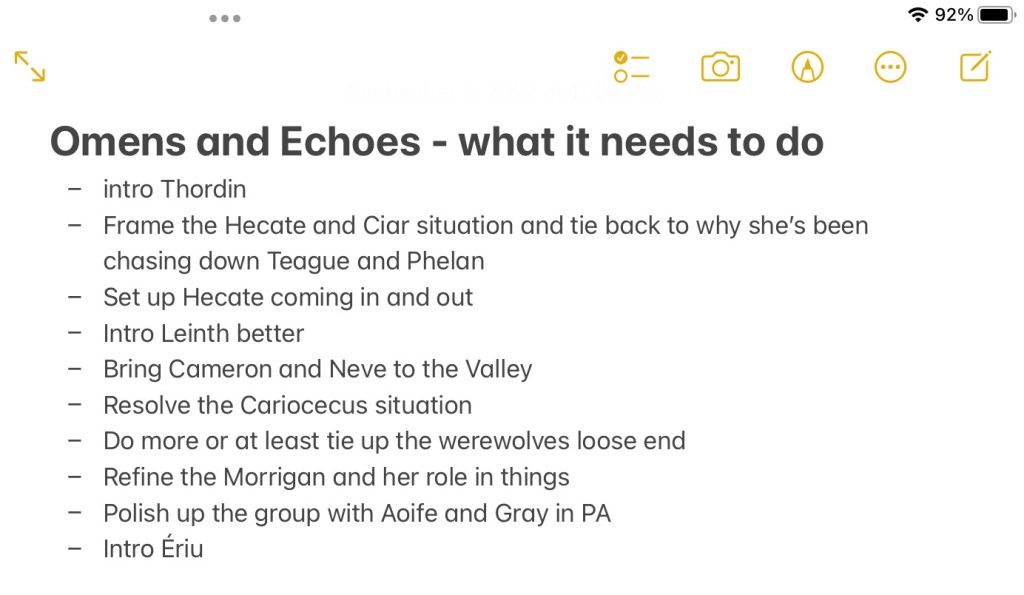
This is the conclusion I’ve come to as a result of (re?)starting the process of working on fixing books 3-7 of the Awakenings series. Of course, it’s a serial, the story predates the serial, and it’s all very complicated and crazy and fun.

It’s a story that I wanted to tell but it was a story that I dove into with barely half a plan which sometimes works out great and sometimes doesn’t. Sometimes writing to a deadline, while it forces you to continue to stretch creative muscles, doesn’t do you many favors.

There’s a lot that needs fixing, needs updating, needs smoothing out—this is true of books 3-7, but also specifically true of some plot and character arcs that turned out to be, in the end, not what they were originally intended to be (I’m looking at you, Matt and Hecate, who took the prize for “biggest surprise” so far—which is not to say other characters didn’t also do this to me because more than a few did). This means I have a lot of material to play with, but there’s also a lot of material that needs tightening up.

Some things will need to be pulled out, new things will be added in. In reviewing the content that ended up being book 3 content (since book 2 and book 3 ended up being mixed around a little bit from how they were originally posted—just to make some things flow better and properly link things together), there’s almost no content with the group that Aoife’s with, which is something that will need to change so their plot arc can be properly tied up in subsequent books. I can’t cut them entirely because a) it wouldn’t make sense to do it given the role some of the characters play later and b) at least one particularly important instance where we see exactly how wild talents and magic can be in the broken world.

In many ways, the books of the Founders Cycle (which comprises the first seven books of the series), is about the survivors learning exactly what they can do—the power they possess—and then stomping down hard on the war that they didn’t start but will play a role in finishing. It’s a fun, interesting arc that takes them through the first few years after the end of everything they knew and one that sets up the Ambrose Cycle that follows—but more on that story sometime to come.

Either way, I’ve got my work cut out for me with all of this.

Awakenings: Book One and War Drums are available where books are sold.

Serials are fun and a mess in a dress

This is the conclusion I’ve come to as a result of (re?)starting the process of working on fixing books 3-7 of the Awakenings series. Of course, it’s a serial, the story predates the serial, and it’s all very complicated and crazy and fun.

It’s a story that I wanted to tell but it was a story that I dove into with barely half a plan which sometimes works out great and sometimes doesn’t. Sometimes writing to a deadline, while it forces you to continue to stretch creative muscles, doesn’t do you many favors.
There’s a lot that needs fixing, needs updating, needs smoothing out—this is true of books 3-7, but also specifically true of some plot and character arcs that turned out to be, in the end, not what they were originally intended to be (I’m looking at you, Matt and Hecate, who took the prize for “biggest surprise” so far—which is not to say other characters didn’t also do this to me because more than a few did). This means I have a lot of material to play with, but there’s also a lot of material that needs tightening up.

Some things will need to be pulled out, new things will be added in. In reviewing the content that ended up being book 3 content (since book 2 and book 3 ended up being mixed around a little bit from how they were originally posted—just to make some things flow better and properly link things together), there’s almost no content with the group that Aoife’s with, which is something that will need to change so their plot arc can be properly tied up in subsequent books. I can’t cut them entirely because a) it wouldn’t make sense to do it given the role some of the characters play later and b) at least one particularly important instance where we see exactly how wild talents and magic can be in the broken world.

In many ways, the books of the Founders Cycle (which comprises the first seven books of the series), is about the survivors learning exactly what they can do—the power they possess—and then stomping down hard on the war that they didn’t start but will play a role in finishing. It’s a fun, interesting arc that takes them through the first few years after the end of everything they knew and one that sets up the Ambrose Cycle that follows—but more on that story sometime to come.

Either way, I’ve got my work cut out for me with all of this.

Awakenings: Book One and War Drums are available where books are sold.