Review: A Furious Sky

I have a thing for learning about natural disasters. It’s something that I’ve discovered about myself over the years–there is something about the whole man versus nature and the events surrounding these experiences that is fascinating to me. As a result of this interest, I picked up A Furious Sky: The Five-Hundred Year History of America’s Hurricanes on Audible during one of their two-for-one sales and gave it a listen.

I got through the book in only a few stretches of time and probably could have listened to the whole thing in a day if I’d had the 10+ hours where I didn’t need to engage with other people beyond the perfunctory. On the audio end of it, it was well-produced and the narrator was very good with the material that he was presenting.

The actual content of the book, for me, was largely familiar territory, though there were some segments of the book that were new material for me. For those who have read or seen documentaries about the Galveston Hurricane, the Labor Day Hurricane, or the Long Island Express, these sections of the book will be very familiar and tell stories that you’ve heard before with very little variation from previous works. If you don’t know much–or anything at all–about these events, though, they offer a striking window into what the experiences of these storms were like. Information about some of the earliest recorded storms was very interesting, and the storms discussed in the mid- to late-twentieth century and beyond offered glimpses into these storms that went beyond the headlines and weather reports.

One of the most interesting aspects of the book was the coverage of how the science of hurricane prediction and the technology involved has evolved over time and continues to evolve. If anything, the book was a worthwhile listen for this information alone. The author, Eric Jay Dolin, is a scholar himself and has synthesized a lot of information into a (relatively) short piece on the subject.

All in all, a worthwhile listen. Definitely recommended to anyone with even a passing interest in the weather–and looking for a slightly heavier but still completely accessible beach read.
Happy June, happy Pride!

We have made it to the sixth month already and wow, has this year gone by both fast and slow at once.  The big news is that I’m not going to grad school in the fall despite efforts to secure a spot in a Ph.D program.  So what does that mean here?  Beyond me looking for a new job to pay the bills at least for the time being, it means that throughout the next year I should have more time to dedicate to writing projects and the podcasts I want to get started, among other things.

Folks in my discord server are already aware of this, but I’ve had a research project that’s been nibbling at my brain for well over a year now, and that’s a broader comparison of responses to the 1918 Flu and the COVID-19 pandemics.  I have some thoughts and some research questions that are floating around, so stay tuned for that both here and on my blog (I’ll be cross-posting, likely with early access to patrons here).  So that will be coming down the pipes.

I have some podcast ideas that are still floating around as well as a TikTok idea that I may or may not roll with sometime in the future (mostly because old newspaper headlines can be WILD).

I’ll be diving back into UNSETIC projects and currently I’m planning on July’s Camp NaNoWriMo project to be writing 50,000 words in that universe, though not limited to any particular project.  Edits are still in the works on Lost and Found and I’m debating whether I’m going to make my own cover (which is what I typically do) or if I’m going to think about hiring someone to design it for me.  Either way, time will tell with regard to what I’m going to do.

Also, it’s Pride, so happy Pride today, this month, and don’t forget that love is love.

Finding the new normal

So this marks the “official” end of the first week of no more undergraduate classes–ordinarily, my last day of classes in a week came on a Thursday, and today is the first Thursday after final exams (though admittedly my last paper wasn’t due until this past Friday).  Grades are in, my name appeared on all the graduation lists, so it is officially done.

Bachelor of Arts, History and Anthropology (2005), Master of Arts, History (2011), Bachelor of Science, Political Science (2021).

It is weird and surreal and at the same time very lowkey and normal, considering I am still working full time at the same place I have been since I started this last degree program and will be at least for the time being (will update on that if something changes).  After the stress of the last few weeks of the semester, I’ve been spending my off time largely trying to get my head back on straight and decompress.  Once I’ve managed that is when I’ll be able to really plan for what comes next, at least in the near term.

A few things are probably in the works based on some things that I’d like to get done and some musings out loud to friends.

  • Podcast or stream based around worldbuilding–possibly both in theory and modeling worldbuilding practices for both fiction and gaming purposes.
  • Return to the edits on Lost and Found, since that’s what it needs.  I’ll tweak cover art and the like once the edits are done–or if I find I need a break from said edits.
  • Planning a TikTok that will possibly be related to a future podcast.  This will involve reading STRANGE HEADLINES (probably historical ones).
  • Get podcasts planned and scripted–I’ve got Wait That Was News? and Fictionalize This! as two that I want to get off the ground
  • Get my writestream schedule back in order
  • Revisit some old projects, assess what I’m going to tackle, get organized

This is just a sampling of the stuff that I’ve got coming down the pipes, but first I’ve got to strike that new balance.  The last time I finished an academic program, Awakenings happened.  I don’t think we’re going to see something quite like that in the near term, but you never know.

Sometimes, things just happen.

Ten. Years.

Today is the tenth anniversary of my webserial, Awakenings.  Ten years ago today, the first post went up.  Back then, it was a twice a week update, one that changed a few months in to three days a week.  Other than a couple of breaks and a few missed posts, it’s been at least 900 words (often more) a week unleashed upon the world in the form of what’s basically an open draft of seven full books–with an eighth currently in progress.

777,000+ words so far and counting.

It was one of those projects that pops into your head out of nowhere, something that lived in my brain for years before I actually started writing what would become Awakenings.  In truth, the first seven books are almost a prequel to what’s being written now–backstory for the post-apocalyptic Arthur story I’d always wanted to write.

Now that story’s happening and five books need editing, polishing, additions and cleanup, even rewriting in some instances, to get the flow right.

It was something I started posting on the suggestion of a friend after I’d finished writing my master’s thesis.  It wasn’t something I’d expected to still be doing now, but I’m not sorry that I am.

Ten years has been a ride.  But it’s not over yet.

Stay tuned, world.  Stay tuned.

Because pens?

I wasn’t actually intending to write this, but I’ve been going on and on about this pen and ink for at least two hours, so I figured maybe it was something that was worth writing a little bit about here–in part because I am at least at the moment mildly obsessed.

So, here’s the story.

For the last few weeks as I’ve been browsing Facebook, I’ve been seeing ads for a fountain pen subscription service.  Now let’s be honest, Facebook doesn’t always have the best algorithm when it comes to me, but I kept tripping over this ad enough to be at least a little intrigued.  So I clicked, I looked, and got a little curious.  This particular company (Truphae, for those curious) is a business that apparently started from the husband’s fascination with fountain pens and he and his wife leveraged it into a really neat business model.  They’ve got a few levels on their subscription boxes.  On that initial visit, I browsed the site, was like ‘huh, that’s cool,’ and moved on, not ready to take the plunge yet.

Then, last week, I happened to see the ad again.  They were running a special on the subscription service so I was finally “well, why not?” and took the plunge.  The option I picked includes a budget-level fountain pen and a full pot of ink.  What’s the harm, right?  I wasn’t sure exactly what I’d get but it was worth a try for a couple months to see how I felt about it.

Holy crap, let me tell you, this was better than I expected on so many levels.

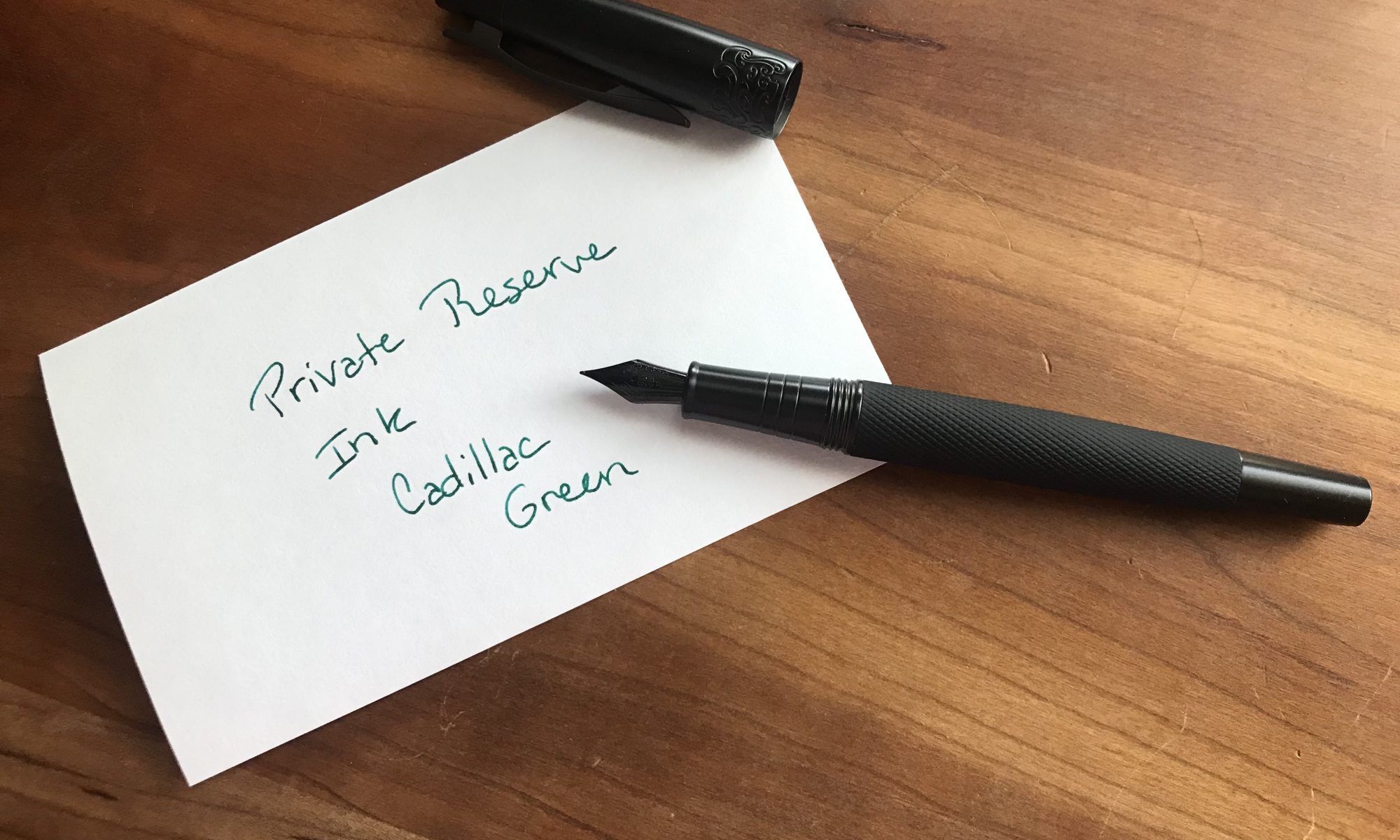
When you hear “budget fountain pen” I’m sure you’re thinking like I did: “something super lightweight and super inexpensive as fountain pens go.”  Well, the last part was fairly on point (the pen I got in my box retails under $25 most places as a basic cartridge pen, anyway – this one is modified so you can easily refill it from ink bottles) but the quality on this pen is much more than I expected.  The casing is all metal and it’s a heavy pen–heavy to the point that I set the cap aside when I’m using it instead of letting it perch on the back of the pen like you usually would.  It was extremely easy to fill (after a couple of YouTube tutorials for a fountain pen beginning like me – all of my previous fountain pens have been cartridge pens which are also great) and writes beautifully.

Then there’s the ink.  The ink pot I got is a pretty big (60ml) and the color is beautiful.  I love colored inks–looking at my notebooks and planners definitely bears this out.  It retails for about $15 across the board at that size and my biggest problem right now is figuring out where I’m going to store the bottle safely because it is definitely still full even after filling the pen.  It’s definitely a green ink (looks very dark in the bottle – you can only tell what color it really is around the edges of it) but once it’s down on paper it’s this beautiful green with a blue undertone to it.  I am admittedly in love and am really, really excited to see what my box next month brings me.  I can’t seem to stop using this pen and ink.

Guess we’ll see what happens…

Three books to help you understand right now

I promised this year some book recommendations as part of my little blogging experiment, but I’m going to apologize in advance: a lot of what I read (and, in some cases, listen to) aren’t exactly cheerful, but they definitely end up being incredibly informative on a lot of levels. I’ve decided to start with the three books below because in many, many ways they help to frame the situation that we are currently living in today–in the case of one of them, have been living in since at least 2016 and in the case of the other two, since roughly March of 2020. If you prefer listening to these books rather than reading them, all are available via Audible and the voice performance on each is excellent.

How Democracies Die by Steven Levitsky and Daniel Ziblatt

How Democracies Die is one of those books that I have not stopped recommending to people since I read it. Coincidentally, I read it as part of a political science class focusing on democracy and authoritarianism and the discussions my class had regarding this book were probably as good as the book itself was (which speaks highly of the quality of conversation that we had in the class). Levitsky and Ziblatt are political scientists who have written academically on competitive authoritarian regimes and the trajectory of governments in Latin America and the post-Soviet bloc, so they definitely know what they’re talking about as they approach the question of democracy–in this case, the threats faced by purportedly strong democracies like the United States, which is their primary focus for this work. They take time to explain the norms and practices of democracy in the United States, describing the “guardrails” of governance and the changes over time within American government. While some of the suggestions they’ve made at the end of the book do not seem to be as possible as they might have been when the book was released three years ago (January 2018), the book is chock full of explanations of how we got to where we’re at and insights onto how to fix at least some of the problems we’re facing.

Pale Rider by Laura Spinney

This is one of two books on the 1918 flu that I’ve listened to recently–coincidentally, the second book I started listening to on the subject and the first one that I finished. Because the 1918 flu is a research interest of mine, I had actually consumed this book well before the pandemic began, then returned to it this summer for a second time through. Pale Rider is extremely accessible for those who are maybe not as fascinated by the historical minutia of how the state of medicine changed in the early twentieth century, offering up the various theories on where the flu started, how it spread, why it came to be called “the Spanish Flu,” and how it affected ordinary people. It gives an incredible overview on the subject and represents an excellent entry-level book to the subject.

The Great Influenza by John M. Barry

In contrast to Pale Rider, The Great Influenza offers a much deeper dive into the history of medicine in the early twentieth century, the science behind combatting the 1918 flu, and how the flu not only reshaped society, but reshaped medicine, especially in the United States. Barry has been in the news on and off throughout the COVID-19 pandemic (I remember reading a few articles he wrote for the Washington Post on the subject throughout 2020) because of his expertise. The Great Influenza is definitely a much thicker, more academic tome than Pale Rider, but it is just as fascinating, if not moreso. The information it provides, too, offers insights into the current behavior of a lot of people in the United States currently suffering major pandemic fatigue–and explains why so many have wanted to deny the severity of the illness in the first place.

All three of the above books offer insights into where we’ve been in the past year. I didn’t find them too depressing–the latter two were much more fascinating than depressing, but I also read both before the pandemic actually started. None of them are necessarily for the faint of heart, but I would suggest that all three are essential reading for anyone who wants to know more about the functioning of American democracy vis-a-vis competitive authoritarian regimes or about the 1918 flu.