Stuff that happens on a train

I wrote on the train yesterday, as one does. These things happen. I’m sure I’ll have more to say about the whole enterprise later, but tl;dr – I had the building urge to try a new flavor of something, and we’ll see where it goes.

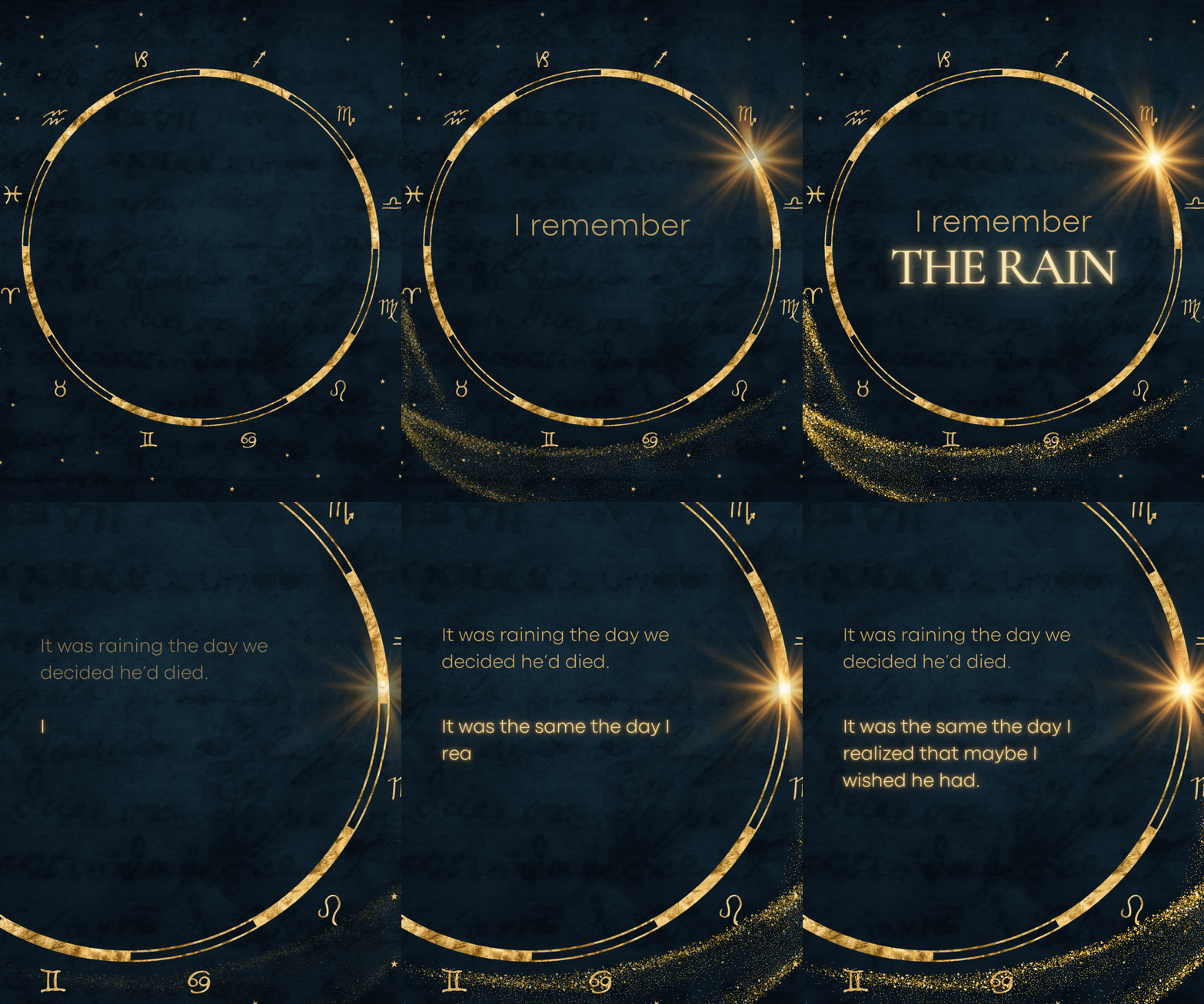
This came from my train writing. Speculate as you see fit.

See my Patreon for a bit more.

Musings on historiography

I am, by training, a historian.  I am also an anthropologist and a political scientist, but by far the most formal training, time, and money spent has been as a historian.

Yes, I know I’m a writer, too, but that is a state of being, not my degree(s).  But it also does certainly tie into being a historian.

Why?

Because historians write—and not just a little.  Historians write a lot.  Part of this is because that’s how our work survives—in monographs and articles and published conference papers, in blog posts and ruminations and our notes.  Writing is and for centuries has been how historians preserve the things that we study and in turn, the writing of other historians is part of how we come to our own understandings of what has been.

Historians write so much that as we progress deeper and deeper into doing history, we all learn about something called historiography.

I just heard a thousand undergrads and probably an equal number of grad students groan.  I get it.  Historiography is hard and can be annoying when all you want to do is be digging through your primary sources and finding that huge new piece of the puzzle that no one else has found before, the answer to the question that no one else has asked.  I get it.  I was there, too.

It has taken a long time for me to really appreciate historiography for what  it is, not just something that we’re forced to do as scholars.  It’s a lens through which we understand our field—it’s our slightly more complicated version of a literature review that would pop up in almost any other field.

Why is it more complicated?  Probably because in doing historiography, we’re not just looking at what other people have talked about before—we’re actually putting together a meta-history of what other scholars have written and argued before.  We are tracing the throughlines of different arguments and interpretations of the past.

Now why would we do that, you might be asking, especially if you’re not necessarily familiar with history as a discipline—or maybe because you are.  We do that because the same way we look at primary source material—whether it be writing, art, records, music, something else—through the lens of the time period it was created in, we also need to look at our secondary sources in the same way.  The influences of time, society, and the situation in which a work was created, scholarly or otherwise, can have a huge impact on how history has been interpreted over time.  Much like other disciplines, you can see different schools of thought—structuralist, post-modernist, the gamut—but it goes deeper than that.

Think about looking at Victorian interpretations of English history—those historians writers had a particular point of view and a particular audience they were writing for, and in turn that influences the work.  A scholar writing in the 1960s may have been radically reinterpreting the work of  a past scholar in a new way, either based on new understandings of the time period or new evidence—or just  by looking at something from another angle.

Historians are constantly in dialogue with history and we are constantly learning new things about the past.  We argue with each other over differing interpretations of evidence in ways that many disciplines don’t—in part, because when we look into the past, we always have to ask ourselves where the line is between what was left behind and what was true.  Every so often, we’ll see a seismic shift in what the discipline sees as the big important questions and who is worthy of study.  It’s part of what makes history so exciting as a discipline—we are constantly learning new things.  It’s also something that can be frustrating about the discipline.

Which brings us back to historiography.

As historians at all levels (whether we know it or not), we work through piles of monographs and articles, slogging through levels upon levels of different interpretations and reassessments.  As you continue to work your way through what’s come before you in the scholarly discourse, you start to see patterns emerge that you can sort into schools of thought or alliances of the same and then reactions to those, reinterpretations of the same evidence, and on and on.  This is why we actually a word for describing that kind of discourse.  In order to be able to do history well, you have to understand how others have done it and how others have understood the same things that you are looking at now.  Of course, there are always gaps.

Usually.

Maybe.

Most historians dream of finding those gaps and writing the seminal work on a particular niche hole in the historiography that may or may not be real.  It’s the dream that dovetails nicely with finding a hidden archive on your favorite subject that no one else knew existed.  Time to fill a big hole.

You know.  Until you find the one unpublished master’s thesis that covered the same material some twenty-odd years earlier.

Do the historiography.  Do the work.  You’ll appreciate it a lot more than you realize later.

I certainly did.

Novembers past and November to come

It was very weird this week to be struck by the sudden realization that I hadn’t spent October thinking through and planning for another round of NaNoWriMo. Up until last year, I had spent almost every October for the last twenty years that way, deciding what I wanted to spend 30 days writing at least 50,000 words on.

My first NaNo was in 2003. My last was in 2023. I had a good run–“winning” more than I lost–and did Camp NaNo over the years here and there, too, in the spring and summer. After a while I didn’t participate in the online community as much, but I did manage to go to a few write-ins in graduate school and then while working through my second bachelor’s degree. It was wonderful and in some ways, I miss those quiet gatherings, the sprints, the coffee and snacks and laughter, the talking through sticky points together and sharing whatever insane yarn we’d come up with for that year.

I think the greatest gift that NaNo ever gave me was the permission to write fast, to write hard, to not worry about whether it was good just that it was down on paper–the permission to be wildly creative without worrying too much. When you have friends writing about sapphic werewolves and alien invasions, you learn those kinds of things.

NaNo was never about writing the great American novel, at least not for me and not for most of the folks I ever interacted with. It was about practicing a craft and telling the stories that were in us, about the actual work of writing and creativity. Even if you didn’t win, you learned something, you got some words toward the million words of practice toward mastery. In a lot of ways, it was magic.

Then the magic died.

It’s weird to think that it’s gone, now, but the writing was on the wall last year with everything that happened. Like for so many things, the stance on AI was the final nail in the coffin. It’s sad, but you also consider that most of the original staff was now gone, and the original magic that was bound up in the whole enterprise was fading.

But that won’t stop a lot of us from settling in this November, as the days grow short and the nights get cold (at least in the northern hemisphere) to work on something new, something old, to write hard and see where our creativity can take us.

I’m no exception. I’ve set myself a challenge and some of what I produce will land here and more will be on my Patreon. There won’t be winning, not this year, not the way there has been before. But there will still be something.

So here’s to the Novembers past and the November yet to come. May it be a creative, magical one.

Thoughts on the promotional landscape

I found myself musing last week about how the advertising landscape—really, the landscape in general—has shifted for creatives over the last 15-20 years or so. For context, started releasing my first serial, Awakenings, in 2011 and probably in that first year and certainly by the second, I was doing some light paid advertising to get it in front of more eyeballs.

That was the heyday of things like serialized fiction (typically on self-hosted sites rather than aggregated spaces like Wattpad or AO3) and tilted more toward original work than fan fiction (not that I didn’t cut my teeth there for a very, very long time). It was also the era of the self-hosted webcomic (I read so many of those in college and grad school). In a lot of ways, the teenage and young adult years of the broadly accessible internet are something I’m sure I’m not the only millennial feels a bit of nostalgia for. Back in those days, there were different kinds of advertising options beyond the ubiquitous shameless self-promotion (which seems increasingly more what we’re expected to do beyond Facebook ads) and I tripped over one called Project Wonderful, which at the time fueled ads on several of the webcomics that I was following.

Now, I haven’t dug too deeply to see if it still exists, but back then, you basically load your advertising budget into a pool, load your different ads (images of different size, static or not) and then could do one of two things: let Project Wonderful pick what would be best for you based on information you put in, including what categories your ad fit into, what kinds of sites you thought your ads would do well on, and how much you wanted to spend per number of impressions, or bid directly on different spots (ie, on sites that you visited yourself). You could also do a combination of both, which is what I usually did.

And I’ll be damned if it didn’t work. At its height, I was getting thousands of hits a day on Awakenings and my other serial after I started advertising them. I wonder now, if I’d decided to advertise my books using Project Wonderful, if I’d have a bigger following now.

It is the only paid advertising I ever did and I can’t say that it didn’t work. This said, I don’t know that it would work the same these days, in our worlds where the algorithms rule our browsing experiences and ad blockers are very much more the norm. Part of what was attractive about Project Wonderful was that you as a site host actually got to pick where you put the advertising boxes, too, which meant you got to figure out how to make it work for your site design. It feels less and less like that these days when you look at so many sites out there that are ad-supported. This said, I don’t know for sure – the last time I hosted any kind of ads, they were from Project Wonderful, and I had some control there.

It’s strange to think sometimes of how much the landscape has changed. Someday I may need to do those Facebook ads (I’m not sold on BookBub) or something similar. It’s going to be a lot of research before that day comes, though, and probably won’t happen until we hit release day for Lost and Found or a similar project.

But we’ll see.

Septembers

There is something about Septembers,

A time of year where things seem to change

For good and bad

But always, for forever.

Never just the single drop

Always the ripples

That become the wave

Become the flood.

Twenty-four Septembers

This September

And nothing will ever be the same.

Rewrites are hard

For this one, the title really says it all – rewrites are ridiculously hard, worse when it’s book 3 of 7 fully posted books in a serial, the first two of which have been lightly polished and unleashed in both ebook and paperback formats. What series is this, you ask?

Awakenings, of course. A serial and series so long in the making, the winding road of starts and stops and restarts and imaginings. Of course it’s a difficult beast to wrangle. In some ways, wrangling the rewrite for book three, Omens and Echoes, is that much harder because of what’s come before–and what I know I want to come after.

In many ways, Omens and Echoes will be the first true rewrite of the series, with added chapters and more than likely some chapters pulled in their entirety or rewritten significantly. Why? Because the story took such a different turn from where I thought it was going in the original draft. I have the benefit of hindsight, now, and more of a road map to where I want to go.

Let’s be honest: anyone reading the first few books of the series would be shocked by what happens by book five (and anyone who’s read the serial probably knows exactly what I’m talking about). The reality is that there are many things that I could do differently and better than I did in the original serialized version, things that I want to do.

it’s just figuring out what stays, what goes, and what the new pieces and undercurrents will be, in addition to smoothing out continuity errors and fixing things here and there. I have accepted that there will always be a few, but I’ve also accepted that those few can also be chalked up to certain characters perhaps not revealing the whole truth, or being delirious, or visions not actually reflecting reality.

I won’t say it’s all fun and games–but I won’t say that it’s not, either.

If you’re a patron of mine on Patreon, you can check out the updated prologue now. Here’s a little taste. Hit the image to get to the post and subscribe if you feel like getting cat pictures and fiction monthly from me.

In want of a title (that might end up being Broken Things)

More of that little “brain why are you like this” project I posted the other day. There’s been over 10,000 words on that out of me in a week. That’s generally a very interesting sign.

Sirens woke me.

The air was thick, heavy—misting rain and humidity and heat and smoke.  Flames crackled too close to be safe but my movements were sluggish, head ringing.  The sirens sounded so far away and yet very, very close.

Help was coming but it didn’t feel fast enough somehow.

It couldn’t have been that long since I’d hit the ground—I wasn’t wet enough for it.  I lurched to my feet and staggered toward where the pilot lay a few yards from me.  One leg was at an odd angle and his flight suit smoldered, as if he’d taken the brunt of the blast somehow, and his helmet was gone.  I didn’t see it anywhere nearby and I wasn’t sure what that meant or if it mattered.

A mumbled curse escaped me as I dropped to my knees next to him, patting out the last of the flames with the sleeves of my sweatshirt and reaching to check his pulse.  Steady, mostly, not stringy and weak like I’d feared given the amount of blood on his face that mixed and ran with the rain.  He was breathing, though each one hitched, as if he couldn’t draw one deep enough.

It was bad.  I knew it was bad, beyond knowing it had to be—he’d crashed a godsdamned plane and it was in pieces behind me.  It was a miracle he was still alive.  In an ER, with more than my bare hands, I’d have maybe been able to do something.  Out here?

Out here all I could do was hope that he made it as far as a hospital.

My mind stumbled through possibilities as I started to be aware of voices, of police telling bystanders to stay back, of the sound of ambulance doors.  It was like time had somehow compressed, or those sirens had been a lot closer than I’d thought.

I focused on his breathing, on his pulse.  I could hear the paramedics coming but they seemed so, so far away.

“Aden.”

Everything seemed to stop.  His voice was a bare whisper, almost lost in the sound of the increasing rain and the crack and roar of the flames that seemed near enough to scorch my spine.  How was he even conscious?  But he was and he was staring at me, eyes dull as he squinted through the falling rain.

“John will be coming,” he whispered.  “Listen to him.  Please.”

The bottom dropped out of my stomach.  There was something about the voice, rough and quiet as it was, that made me feel hollow, like I’d forgotten something important.  For a few seconds, he held my gaze.  There was something familiar about the stormy color of his eyes and the tarnished silver ring around the edge, tugging on something anchored in my soul.  But I didn’t know any pilots or anyone who worked for Eden.

Right?

A breath shuddered out of him and his eyes fluttered shut.

No.

A quiet thud shook me from my shock and I twisted to look up at the paramedic who took a knee beside me, his partner quickly moving around to the other side of the now unconscious pilot.  “Did you find him like this?” the paramedic asked.

I shook my head.  “No.  He was still in the cockpit.  Barely got him out before something exploded.  He was—”  I stopped, swallowing hard.  What if I’d imagined it?  “He was conscious a second ago.”

“That seems like a miracle,” the other paramedic muttered.

“Pulse was steady,” I said, starting to rock to my feet.  “Don’t know how much trauma is there.  I blacked out when the—I don’t know what it was exploded.  His helmet was still on when I got to him.  He was still strapped into the cockpit.”

“Okay,” the first paramedic said, squeezing my arm for a second.  “We got it from here, doc.  Should be someone else coming with the fire department that can check you, okay?  Don’t go far.”

I blinked at him, then shook my head, wincing as I realized that I had a lump on the back of my head the size of an orange.  “Oh.”

The paramedic flashed me a quick smile that faded quickly as he turned back to the pilot in front of him.  I didn’t remember their names, but they seemed to know me.

Of course they knew me.

I don’t want to go to the hospital.  I backed away slowly, watching the paramedics with the pilot.  I probably needed to, though—I was almost certainly concussed, given the lump on my head and the few minutes of lost time, to say nothing of my potential hallucination.

There was no way that was real.  He couldn’t have been awake.  There’s just—there’s too much.

There’s too much.  He couldn’t have been awake.

Staring at the pilot, I knew that I had to be telling myself the truth.  I must have imagined it—that was the only explanation.  That was why he’d seemed familiar somehow, why I’d somehow known the voice, his eyes.

How he’d known my name.

I convinced myself that it was true and that was the only reason I let them load me into the front seat of the ambulance ten minutes later.  Better to be safe than sorry.

The pilot, still somehow alive, was in the back.

Behind us, in Barrow Park in the middle of the suburbs, the plane burned.