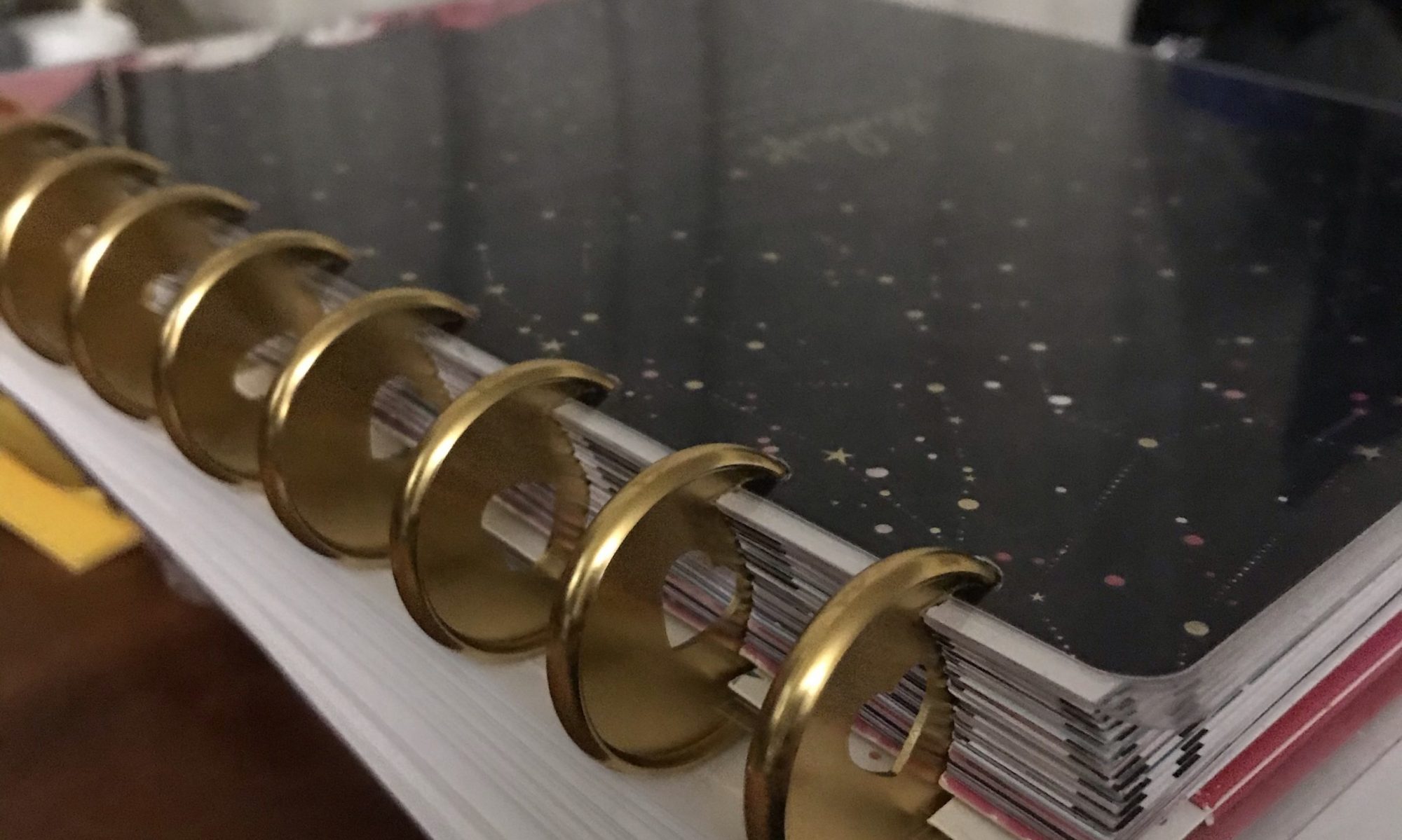
Would you be interested in getting a monthly postcard of some kind? Probably nothing special, just a fun postcard with a note.
Ten. Years.
Today is the tenth anniversary of my webserial, Awakenings. Ten years ago today, the first post went up. Back then, it was a twice a week update, one that changed a few months in to three days a week. Other than a couple of breaks and a few missed posts, it’s been at least 900 words (often more) a week unleashed upon the world in the form of what’s basically an open draft of seven full books–with an eighth currently in progress.
777,000+ words so far and counting.
It was one of those projects that pops into your head out of nowhere, something that lived in my brain for years before I actually started writing what would become Awakenings. In truth, the first seven books are almost a prequel to what’s being written now–backstory for the post-apocalyptic Arthur story I’d always wanted to write.
Now that story’s happening and five books need editing, polishing, additions and cleanup, even rewriting in some instances, to get the flow right.
It was something I started posting on the suggestion of a friend after I’d finished writing my master’s thesis. It wasn’t something I’d expected to still be doing now, but I’m not sorry that I am.
Ten years has been a ride. But it’s not over yet.
Stay tuned, world. Stay tuned.
Because pens?
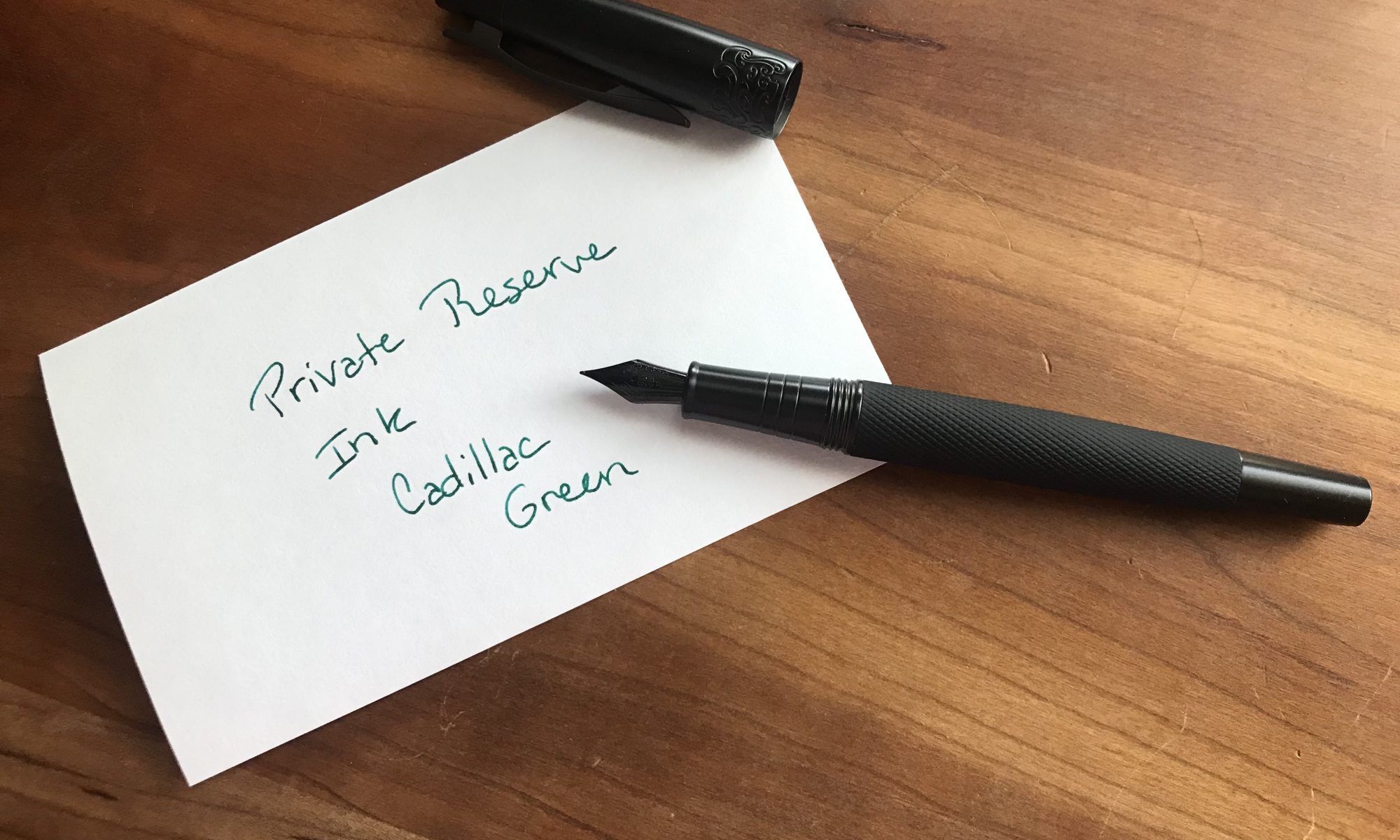
I wasn’t actually intending to write this, but I’ve been going on and on about this pen and ink for at least two hours, so I figured maybe it was something that was worth writing a little bit about here–in part because I am at least at the moment mildly obsessed.
So, here’s the story.
For the last few weeks as I’ve been browsing Facebook, I’ve been seeing ads for a fountain pen subscription service. Now let’s be honest, Facebook doesn’t always have the best algorithm when it comes to me, but I kept tripping over this ad enough to be at least a little intrigued. So I clicked, I looked, and got a little curious. This particular company (Truphae, for those curious) is a business that apparently started from the husband’s fascination with fountain pens and he and his wife leveraged it into a really neat business model. They’ve got a few levels on their subscription boxes. On that initial visit, I browsed the site, was like ‘huh, that’s cool,’ and moved on, not ready to take the plunge yet.
Then, last week, I happened to see the ad again. They were running a special on the subscription service so I was finally “well, why not?” and took the plunge. The option I picked includes a budget-level fountain pen and a full pot of ink. What’s the harm, right? I wasn’t sure exactly what I’d get but it was worth a try for a couple months to see how I felt about it.
Holy crap, let me tell you, this was better than I expected on so many levels.
When you hear “budget fountain pen” I’m sure you’re thinking like I did: “something super lightweight and super inexpensive as fountain pens go.” Well, the last part was fairly on point (the pen I got in my box retails under $25 most places as a basic cartridge pen, anyway – this one is modified so you can easily refill it from ink bottles) but the quality on this pen is much more than I expected. The casing is all metal and it’s a heavy pen–heavy to the point that I set the cap aside when I’m using it instead of letting it perch on the back of the pen like you usually would. It was extremely easy to fill (after a couple of YouTube tutorials for a fountain pen beginning like me – all of my previous fountain pens have been cartridge pens which are also great) and writes beautifully.
Then there’s the ink. The ink pot I got is a pretty big (60ml) and the color is beautiful. I love colored inks–looking at my notebooks and planners definitely bears this out. It retails for about $15 across the board at that size and my biggest problem right now is figuring out where I’m going to store the bottle safely because it is definitely still full even after filling the pen. It’s definitely a green ink (looks very dark in the bottle – you can only tell what color it really is around the edges of it) but once it’s down on paper it’s this beautiful green with a blue undertone to it. I am admittedly in love and am really, really excited to see what my box next month brings me. I can’t seem to stop using this pen and ink.
Guess we’ll see what happens…
Three books to help you understand right now
I promised this year some book recommendations as part of my little blogging experiment, but I’m going to apologize in advance: a lot of what I read (and, in some cases, listen to) aren’t exactly cheerful, but they definitely end up being incredibly informative on a lot of levels. I’ve decided to start with the three books below because in many, many ways they help to frame the situation that we are currently living in today–in the case of one of them, have been living in since at least 2016 and in the case of the other two, since roughly March of 2020. If you prefer listening to these books rather than reading them, all are available via Audible and the voice performance on each is excellent.
How Democracies Die by Steven Levitsky and Daniel Ziblatt
How Democracies Die is one of those books that I have not stopped recommending to people since I read it. Coincidentally, I read it as part of a political science class focusing on democracy and authoritarianism and the discussions my class had regarding this book were probably as good as the book itself was (which speaks highly of the quality of conversation that we had in the class). Levitsky and Ziblatt are political scientists who have written academically on competitive authoritarian regimes and the trajectory of governments in Latin America and the post-Soviet bloc, so they definitely know what they’re talking about as they approach the question of democracy–in this case, the threats faced by purportedly strong democracies like the United States, which is their primary focus for this work. They take time to explain the norms and practices of democracy in the United States, describing the “guardrails” of governance and the changes over time within American government. While some of the suggestions they’ve made at the end of the book do not seem to be as possible as they might have been when the book was released three years ago (January 2018), the book is chock full of explanations of how we got to where we’re at and insights onto how to fix at least some of the problems we’re facing.
Pale Rider by Laura Spinney
This is one of two books on the 1918 flu that I’ve listened to recently–coincidentally, the second book I started listening to on the subject and the first one that I finished. Because the 1918 flu is a research interest of mine, I had actually consumed this book well before the pandemic began, then returned to it this summer for a second time through. Pale Rider is extremely accessible for those who are maybe not as fascinated by the historical minutia of how the state of medicine changed in the early twentieth century, offering up the various theories on where the flu started, how it spread, why it came to be called “the Spanish Flu,” and how it affected ordinary people. It gives an incredible overview on the subject and represents an excellent entry-level book to the subject.
The Great Influenza by John M. Barry
In contrast to Pale Rider, The Great Influenza offers a much deeper dive into the history of medicine in the early twentieth century, the science behind combatting the 1918 flu, and how the flu not only reshaped society, but reshaped medicine, especially in the United States. Barry has been in the news on and off throughout the COVID-19 pandemic (I remember reading a few articles he wrote for the Washington Post on the subject throughout 2020) because of his expertise. The Great Influenza is definitely a much thicker, more academic tome than Pale Rider, but it is just as fascinating, if not moreso. The information it provides, too, offers insights into the current behavior of a lot of people in the United States currently suffering major pandemic fatigue–and explains why so many have wanted to deny the severity of the illness in the first place.
All three of the above books offer insights into where we’ve been in the past year. I didn’t find them too depressing–the latter two were much more fascinating than depressing, but I also read both before the pandemic actually started. None of them are necessarily for the faint of heart, but I would suggest that all three are essential reading for anyone who wants to know more about the functioning of American democracy vis-a-vis competitive authoritarian regimes or about the 1918 flu.
This is 2021
Well, we are now exactly a week into 2021 and…it’s already been a trip, hasn’t it? We’re still wrestling with a public health crisis that’s not going away anytime soon, still dealing with vaccination shortfalls and supply issues, and just this Wednesday, supporters of He-Who-Shall-Not-Be-Named stormed the Capitol with the intent of a) preventing the certification of the legitimate election of Joseph R. Biden Jr. and Kamala Harris as president and vice president respectively and b) taking over the government in order to ensure the continued power of He-Who-Shall-Not-Be-Named. I have a lot of thoughts on this, but that’s going to be saved for another blog. Probably.
As of this writing, I am eleven days out from the beginning of my last undergraduate semester for my second bachelor’s degree. Hopefully within the next six weeks I will know where I am going to graduate school (people keep telling me that I am going to get in and I am not up to 100% believing them in case my hopes are dashed). Applied for four doctoral programs, all in the Chicago area, for those who are curious.
Going into this year, I’d decided to diversify my activities just a little bit. I’ve been pondering podcasts for over a year now and I believe there are at least two that will be in the offing hopefully by June (but let’s not jinx myself and promise them by then). The first of these is Fictionalize This! which will present bites of historical, scientific, or other interesting information with the challenge to listeners who are so inclined to figure out how to use that to inspire their fiction. The second idea is actually the one that I will probably end up launching first is Wait, THAT Was News? which will examine and contextualize old newspaper articles because old newspaper articles are wild. If you’ve never read any, you’re in for a treat.
This is, of course, in addition to all of the writing I do–both fictional work and academic. Expect to see more of that from me this year, and also expect (again, hopefully by summer) the release of the next UNSETIC Files book, Lost and Found. It’s still in the editing stages, but that should be done in the next few months. Last year for Christmas my brother and sister-in-law got me some awesome editing pencils and I have very much enjoyed using them in my editing processes. I also hope to have another Awakenings edited book out by the end of the year, but that is a bit more of an arduous process given its very nature.
Expect to see more essays, more fiction, and more thoughts this year, regardless.
Welcome to 2021. Let’s hope that, at the very least, this year is different from the last.
Epsilon background: letter from Ben Raymond to JJ Collins
JJ,
I hope this note finds you well. I’ve been thinking about what you said in your last message, about what life would be like once the fighting ends. I could read the subtext without you having to telegraph anything, and that subtext worries me. I’m beginning to question everything I thought I knew.
Almost everything. I bought the ring. We’re supposed to spend some time together next week—I have some leave slotted and she’s made arrangements to rent a sailboat so we can sail up the coast and enjoy the quiet. She doesn’t think I know about the cottage and I don’t have it in me to ruin the surprise. I just hope that it feels like the right time to do it while we’re out there.
Life’s too short to keep waiting for the perfect moment, right? Especially if what you didn’t say is true. Why waste what we have?
Docket is routine for the next few weeks on my end. I imagine it’s a lot of the same on yours. Heard about the new flagship—good luck with the shakedown cruise. Hopefully the luck’s not needed, but you never know when the ship’s on her maiden. There’s always a few kinks to work through, right?
I’ll let you know how the trip goes one way or another. Cross your fingers that I don’t chicken out again.
Step lightly out there,
Ben
Epsilon background: Notes from History of the Preytax Wars
I was not supposed to be at Beta Centauri when it happened. It was only a short visit, a chance to see my sister before I left for the fringes of human-held space. I was still nominally a civilian then, signed on as a translator and recorder for a diplomatic mission on faraway Robinsworld. We didn’t know then that the settlement there had already been obliterated and the survivors scattered. We didn’t know then that the people I was set to meet had been lost.
We didn’t know then that Irin and I were about to be the last survivors of the Collins line. Our brother had been killed the year before under mysterious circumstances, circumstances even Irin couldn’t get to the bottom of with her meager security clearance and the power of her name. Dad had tried, too, but even he came up empty. He often said if Granddad was still alive, maybe he’d have gotten farther, but I don’t think he would have. My grandfather was well-respected and well-known, but in those days when the government was scrambling to keep the volume of the mysterious losses a secret, I doubt anyone not already in the know could have found out much. Not even him, for all his storied history and lifetime of service, both in and out of uniform.
I never intended to join the armed forces, but when the Preytax hit Beta Centauri, there weren’t any choices left.
Of course, she wasn’t the one to recruit me or to swear me in—that was done by the base commander at Beta Centauri, about ten hours before he was killed. Under normal circumstances, I wouldn’t have ended up assigned to her unit—if you could call my assignment anything formal at all. But things were different when the war broke out, when Beta Centauri was hit as the Preytax made their first major push on Earth-held worlds. The attacks were designed to cripple and demoralize, to wipe out as much resistance as possible.
In a lot of ways, it was successful. It just didn’t do the whole job. They didn’t finish us off. It was probably a mistake on their part, but I don’t know if they ever realized it or if that was part of some greater plan. Short of talking to one of them—and I have had more than enough firsthand experience with them already to last me the rest of my life—and asking the question, I have no way of knowing.
I do not think I want to know.
The day Beta Centauri fell and we fled was also the first time I almost got myself killed. It’s never auspicious to that it was the first time that happened, because it implies it happened again. But it did, and that’s something I can’t deny, nor would I exactly want to. Scars and experiences are part of what make us who we are. After Beta Centauri, I started being more afraid for my sister than I was for myself. The why is a long story that I still can’t quite bring myself to tell—at least not yet. Maybe someday, but not today.
Maybe not ever.
I say we fled from Beta Centauri though I know that isn’t the way I should talk about it or write about it—once I get the account down on paper, so to speak, I imagine I’ll couch it in much more neutral language, but the truth of it is that we really did flee. It wasn’t a retreat, it was an escape. We should have died there. It was a miracle that Irin managed to get the 19th off that planet alive.
A week later, we picked up the survivors from Luke Ross’s support detachment out of Io while we were looking for anyone else to had survived that blitz attack. Their escape had been even more narrow than ours, successful only thanks to one really good pilot-navigator pairing and a timely wave of solar radiation that wasn’t blocked by Jupiter or anything else. From what I understand based on talking to the navigator, the radiation temporarily blinded the sensors the Preytax were using to monitor the debris in orbit of the moon—and there was a lot of debris of various sizes and shapes because the Preytax had basically blown everything they could to kingdom come—long enough for them to make their run for it.
Really, that’s where the actual story that’s fascinated so many people starts—the Stormers’ escape from Beta Centauri, the rescue of the 15th Support Detachment. Circumstances and chance threw us all together and out of it came something that ended up working better than any of us ever expected. My sister turned out to be smarter than anyone had ever given her credit for, ruthless and compassionate in turns, and in those weeks and months when the structures of the military and the government were scrambling to reestablish themselves in the strange and devastating new normal we’d found ourselves in. It was both terrifying and exhilarating.
A lot changed in those months after Beta Centauri, after Earth was hit and occupied. Some of it, at least, was for the better.