Musings on historiography

I am, by training, a historian.  I am also an anthropologist and a political scientist, but by far the most formal training, time, and money spent has been as a historian.

Yes, I know I’m a writer, too, but that is a state of being, not my degree(s).  But it also does certainly tie into being a historian.

Why?

Because historians write—and not just a little.  Historians write a lot.  Part of this is because that’s how our work survives—in monographs and articles and published conference papers, in blog posts and ruminations and our notes.  Writing is and for centuries has been how historians preserve the things that we study and in turn, the writing of other historians is part of how we come to our own understandings of what has been.

Historians write so much that as we progress deeper and deeper into doing history, we all learn about something called historiography.

I just heard a thousand undergrads and probably an equal number of grad students groan.  I get it.  Historiography is hard and can be annoying when all you want to do is be digging through your primary sources and finding that huge new piece of the puzzle that no one else has found before, the answer to the question that no one else has asked.  I get it.  I was there, too.

It has taken a long time for me to really appreciate historiography for what  it is, not just something that we’re forced to do as scholars.  It’s a lens through which we understand our field—it’s our slightly more complicated version of a literature review that would pop up in almost any other field.

Why is it more complicated?  Probably because in doing historiography, we’re not just looking at what other people have talked about before—we’re actually putting together a meta-history of what other scholars have written and argued before.  We are tracing the throughlines of different arguments and interpretations of the past.

Now why would we do that, you might be asking, especially if you’re not necessarily familiar with history as a discipline—or maybe because you are.  We do that because the same way we look at primary source material—whether it be writing, art, records, music, something else—through the lens of the time period it was created in, we also need to look at our secondary sources in the same way.  The influences of time, society, and the situation in which a work was created, scholarly or otherwise, can have a huge impact on how history has been interpreted over time.  Much like other disciplines, you can see different schools of thought—structuralist, post-modernist, the gamut—but it goes deeper than that.

Think about looking at Victorian interpretations of English history—those historians writers had a particular point of view and a particular audience they were writing for, and in turn that influences the work.  A scholar writing in the 1960s may have been radically reinterpreting the work of  a past scholar in a new way, either based on new understandings of the time period or new evidence—or just  by looking at something from another angle.

Historians are constantly in dialogue with history and we are constantly learning new things about the past.  We argue with each other over differing interpretations of evidence in ways that many disciplines don’t—in part, because when we look into the past, we always have to ask ourselves where the line is between what was left behind and what was true.  Every so often, we’ll see a seismic shift in what the discipline sees as the big important questions and who is worthy of study.  It’s part of what makes history so exciting as a discipline—we are constantly learning new things.  It’s also something that can be frustrating about the discipline.

Which brings us back to historiography.

As historians at all levels (whether we know it or not), we work through piles of monographs and articles, slogging through levels upon levels of different interpretations and reassessments.  As you continue to work your way through what’s come before you in the scholarly discourse, you start to see patterns emerge that you can sort into schools of thought or alliances of the same and then reactions to those, reinterpretations of the same evidence, and on and on.  This is why we actually a word for describing that kind of discourse.  In order to be able to do history well, you have to understand how others have done it and how others have understood the same things that you are looking at now.  Of course, there are always gaps.

Usually.

Maybe.

Most historians dream of finding those gaps and writing the seminal work on a particular niche hole in the historiography that may or may not be real.  It’s the dream that dovetails nicely with finding a hidden archive on your favorite subject that no one else knew existed.  Time to fill a big hole.

You know.  Until you find the one unpublished master’s thesis that covered the same material some twenty-odd years earlier.

Do the historiography.  Do the work.  You’ll appreciate it a lot more than you realize later.

I certainly did.
Novembers past and November to come

It was very weird this week to be struck by the sudden realization that I hadn’t spent October thinking through and planning for another round of NaNoWriMo. Up until last year, I had spent almost every October for the last twenty years that way, deciding what I wanted to spend 30 days writing at least 50,000 words on.

My first NaNo was in 2003. My last was in 2023. I had a good run–“winning” more than I lost–and did Camp NaNo over the years here and there, too, in the spring and summer. After a while I didn’t participate in the online community as much, but I did manage to go to a few write-ins in graduate school and then while working through my second bachelor’s degree. It was wonderful and in some ways, I miss those quiet gatherings, the sprints, the coffee and snacks and laughter, the talking through sticky points together and sharing whatever insane yarn we’d come up with for that year.

I think the greatest gift that NaNo ever gave me was the permission to write fast, to write hard, to not worry about whether it was good just that it was down on paper–the permission to be wildly creative without worrying too much. When you have friends writing about sapphic werewolves and alien invasions, you learn those kinds of things.

NaNo was never about writing the great American novel, at least not for me and not for most of the folks I ever interacted with. It was about practicing a craft and telling the stories that were in us, about the actual work of writing and creativity. Even if you didn’t win, you learned something, you got some words toward the million words of practice toward mastery. In a lot of ways, it was magic.

Then the magic died.

It’s weird to think that it’s gone, now, but the writing was on the wall last year with everything that happened. Like for so many things, the stance on AI was the final nail in the coffin. It’s sad, but you also consider that most of the original staff was now gone, and the original magic that was bound up in the whole enterprise was fading.

But that won’t stop a lot of us from settling in this November, as the days grow short and the nights get cold (at least in the northern hemisphere) to work on something new, something old, to write hard and see where our creativity can take us.

I’m no exception. I’ve set myself a challenge and some of what I produce will land here and more will be on my Patreon. There won’t be winning, not this year, not the way there has been before. But there will still be something.

So here’s to the Novembers past and the November yet to come. May it be a creative, magical one.

Thoughts on the promotional landscape

I found myself musing last week about how the advertising landscape—really, the landscape in general—has shifted for creatives over the last 15-20 years or so. For context, started releasing my first serial, Awakenings, in 2011 and probably in that first year and certainly by the second, I was doing some light paid advertising to get it in front of more eyeballs.

That was the heyday of things like serialized fiction (typically on self-hosted sites rather than aggregated spaces like Wattpad or AO3) and tilted more toward original work than fan fiction (not that I didn’t cut my teeth there for a very, very long time). It was also the era of the self-hosted webcomic (I read so many of those in college and grad school). In a lot of ways, the teenage and young adult years of the broadly accessible internet are something I’m sure I’m not the only millennial feels a bit of nostalgia for. Back in those days, there were different kinds of advertising options beyond the ubiquitous shameless self-promotion (which seems increasingly more what we’re expected to do beyond Facebook ads) and I tripped over one called Project Wonderful, which at the time fueled ads on several of the webcomics that I was following.

Now, I haven’t dug too deeply to see if it still exists, but back then, you basically load your advertising budget into a pool, load your different ads (images of different size, static or not) and then could do one of two things: let Project Wonderful pick what would be best for you based on information you put in, including what categories your ad fit into, what kinds of sites you thought your ads would do well on, and how much you wanted to spend per number of impressions, or bid directly on different spots (ie, on sites that you visited yourself). You could also do a combination of both, which is what I usually did.

And I’ll be damned if it didn’t work. At its height, I was getting thousands of hits a day on Awakenings and my other serial after I started advertising them. I wonder now, if I’d decided to advertise my books using Project Wonderful, if I’d have a bigger following now.

It is the only paid advertising I ever did and I can’t say that it didn’t work. This said, I don’t know that it would work the same these days, in our worlds where the algorithms rule our browsing experiences and ad blockers are very much more the norm. Part of what was attractive about Project Wonderful was that you as a site host actually got to pick where you put the advertising boxes, too, which meant you got to figure out how to make it work for your site design. It feels less and less like that these days when you look at so many sites out there that are ad-supported. This said, I don’t know for sure – the last time I hosted any kind of ads, they were from Project Wonderful, and I had some control there.

It’s strange to think sometimes of how much the landscape has changed. Someday I may need to do those Facebook ads (I’m not sold on BookBub) or something similar. It’s going to be a lot of research before that day comes, though, and probably won’t happen until we hit release day for Lost and Found or a similar project.

But we’ll see.

Submerged Rock (troll)

One of my favorite places in the whole damn world is Museum Campus on Chicago’s lakeshore, specifically the area around the Field Museum and the Shedd Aquarium.  On occasion, usually when the weather is good or I have time to kill or just feel the need, I’ll walk down along the walking and biking paths in the area, the ones that wrap down around the back of the aquarium, whose edges drop straight down into Lake Michigan.  Sometimes they’re closed off because of ice or because the waves on the lake are too high, making them dangerous to walk.  Sometimes even when they’re open, you’ll get sprayed by water from a freshwater sea that isn’t as the waves crash against the edge of these pathways.

It’s one of those places that I sometimes wonder if visitors ever think to wander along, or if it tends to be the provenance of locals, who bike along it in their lane, take their morning runs along the slanting walkways and the quiet that can come in those spaces, especially before the day really begins.  The view is really spectacular, even on misty days when the fog hangs heavy over the water and you can’t even see the park a few hundred yards away.  Of course, maybe I’m biased.  It is, after all, one of my favorite places, and I know that if I lived in the city I’d be there as often as I could be, convenience be damned.

Another point in favor of my eventually moving there, I guess.

Along one of those pathways are old warmings painted onto the pavement, telling passersby—and anyone who might consider jumping into the water—that there are submerged rocks in the area along the shore.  On the one hand, it seems silly that the warning would be needed.  It’s not a beach, not a swimming area, but there are certainly folks who fish along that pathway amongst the runners and the cyclists and wanderers.  The warning would be as much for them, who could lose a line in those rocks, or anyone who falls in or would-be rescuers.

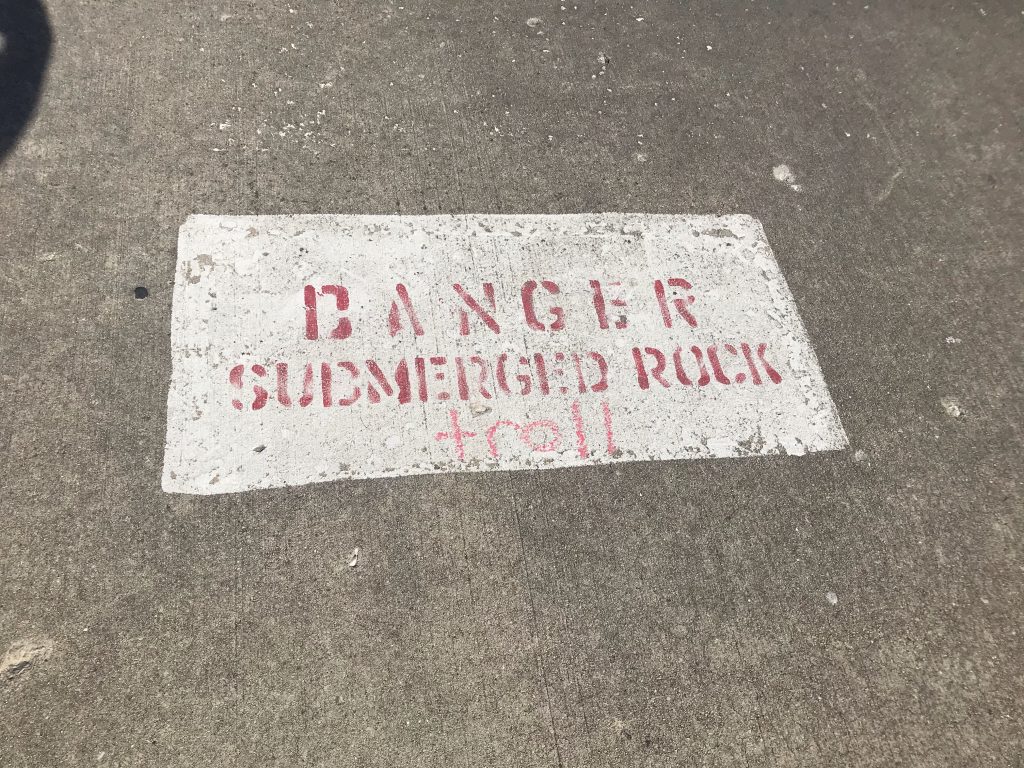
Five years ago while walking the pathway, I snapped a picture of one of those warnings.  Someone with a sense of humor and a touch of whimsy decided to add a bit of extra flavor to one of those warnings.  I haven’t been back in the last year or so to see if it’s still there or if it’s been repainted, but it was still there a few years ago, the last time I was able to come down while the weather was good enough to wander down toward the water.

Spotted in the wild out on Museum Campus, behind the Shedd Aquarium

I’ve wondered since the first time I saw it—it’s been there for a lot longer than five years—about whoever painted the word “troll” onto that warning.  A college kid on a dare, a nerdy one out with friends?  High schoolers out for a laugh?  A creative with a penchant for a little bit of graffiti?

There’s a story behind it, one I know that I will never know.  Somehow, though, that makes it that much more interesting, that much more magical.  A touch of whimsy to the mundane, something that exists if you’re willing to find it.  That’s a little something we all need, now more than ever.  A little touch of magic to a gray, hard world.

So here’s to the magic makers and those who seek it—the ones that make joy and those who find pleasure in what’s been made.