Let the insanity begin…

Working on the redraft of When All’s Said and Done as we speak!  And mucking around with a tracker widget that doesn’t seem to want to work quite properly… Edit: the widget is, in fact, working, just not the way I want it to on my sidebar.

The beginning of this monster is a beast, because I can’t quite figure out how I want to start it.  Oh well.  I’ll fix it later if I decide to!

Back to writing…

Edit: Over 7,000 words as of 11:45 EST. Will be calling it a night soon.

The coming April insanity…

The thesis is done, turned in, and will be out for binding next week.  This means I suddenly have quite a bit more free time, and it’s high time I dedicated some of it to fiction once again.  Not just reading fiction, but writing it as well.  Since I’ve never been one for writing scripts, and April is Script Frenzy month from the OLL (the wonderful, crazy people who bring us Nanowrimo every year), I’ve decided it’s high time that I start redrafting my first even Nanowrimo project, When All’s Said and Done.  The characters have been on my mind of late, and it feels like it’s time.

There’s going to be major changes from the original draft to the second, in part due to the ramble I started scribbling last summer, one that’s brought a character that knows what’s going on inside the Institute into direct contact with Ky again, rather unexpectedly.  Because Ridley knows a lot of what’s going on inside, more than Hadrian ever could find out due to the rapid decline of his health, some of the twists in the original draft will need to be reworked.  It’s all Julia’s fault, really.  She brought him to Damon (her cousin who happens to be Matthew’s longtime friend), which means Damon called Matthew and everyone got involved with each other quite a bit faster than in the original draft, though I think that having Damon knee-deep from the start will work better.  He can still be a little annoyed with Matthew, but not nearly as annoyed as he was in the original draft.

Having Ridley there and able to tell Ky and Matthew things, however, does throw into question some plot twists, including the one that involves Tim Thatcher.  I suppose I’ll cross that bridge when I get there.  Before I do anything else, I need to decide what’s going to happen with the installation at Andover Commonwealth…whether they abandon it, or believe it’s secure in the wake of Ridley’s escape from the village with Julia’s help.

I imagine Reverend Stonard might pop up in When All’s Said and Done, too.  He seems as if he’d make a good villain.  And Laren, of course, trying to lay low.  The Tina character may disappear completely, since the new version will begin in August rather than November.

A lot to think about, and only a few days before I begin to redraft!  What fun will this be…

Musings on YA fiction and projects left unfinished

I’ve been writing fiction since I was ten years old–for fun, serious writing, not because I had to for school or any other reason.  Most of it has been crap.  Some of it’s been okay.  I haven’t reached a point where I have a manuscript ready to send off to agents or publishers…but that will come sooner rather than later, I’d suspect.

Today, in the midst of cleaning the house and weeding out in the garden, I came across a few of my writing magazines that I hadn’t finished reading–this happens often enough, that I’ll get one of them and not finish reading them to my satisfaction and then they get shuffled someplace in an effort to get my mother to stop complaining about how everyone’s stuff is everywhere cluttering up her house (not going to offer commentary on that one).  So, at some point today I sat down on the couch and thumbed through an article from the May/June 2010 issue of Writer’s Digest that had YA agents and editors talking about the category — how to break into it, what they’re looking for, that kind of thing.

It got me to thinking a bit.  I’ve always written younger protagonists (there are a few notable exceptions, including several of the major supporting cast members in Epsilon and The Last Colony–heck, Adam Windsor is a PoV character in The Last Colony and he’s in his fifties–as well as characters in Fate and Second Chances and its untitled sequel…though I’m not entirely sure elves and dragons count as “older protagonists”), characters ranging from their late teens through their twenties.  In some ways, my characters have aged with me and in others, they certainly have not.

Paranormal and speculative fiction have become huge in young adult fiction, and that subsegement of the genre have yielded works that have transcended the age category (see: Harry Potter and as much as I hate to mention it, Twilight–Vampires do not sparkle thank you very much!).  To carry this even further and away from the article I read, manga, Japanese graphic novels, tend to have speculative, paranormal, and fantastic elements to them as a matter of course.  Manga is extremely popular in the United States–and growing in popularity all the time.

Which brings me to what really got me thinking–the untitled sequel to my D&D-inspired Fate and Second Chances already has two very strong teenage protagonists in it–Alysta Riverden and Kaelen Verrel–and could quite possibly be transformed into a YA novel.  It’s something I’ll have to think about, because the story as it stands right now (in its very early stages–there’s only about 23500 words of ramble to it) is planned to be about as much about Alysta’s father, Talasin, as it is about Lysta and Kael.

But it’s entirely possible, and could be fun.  I’ll just have to do some homework on it, and some thinking.  But maybe.  Just maybe…

…after all, high adventure does well, too.

Ah, the joys of freewriting (or how it took me 14 pages to figure out who I was talking about)

So for the past week or so I’ve been feeling the need to put pen to paper (literally) and do some freewriting.  I don’t do it often and so when the mood strikes, it’s strange.  So between thesis and cleaning, I’ve been freewriting.  I’m up to fourteen handwritten pages (almost fourteen pages, there’s only a few lines left on page 14 to write).  Freewriting is a strange thing…you never know what’s going to happen.

So I started with a first person point of view and rambled.  My narrator told me pretty quickly that her name was Julia (Julia Rhiannon, no less) and that she’d been living in this creepy little midwestern town for a few months because she’d been taking care of a sick (now deceased) relative that she’d been visiting there since she was eight.  Most of the town, especially the good Reverend at the local evangelical chapel, give her the heebie-jeebies.

Then there was this boy–maybe about her age, maybe a little younger, a mysterious, broken thing that on the surface looked crazy, “special,” or drugged.  He kept popping up, kept looking for her.  She found out his name was Darien fairly early on.  He came to her in moments of almost-lucidity and asked for her help.

Now…I knew by this point (heck, I knew by a few lines into the first page) that this story is in the same universe as my first Nanowrimo project ever, When All’s Said and Done, which has been on my mind in between thinking about Edward I and III because it’s about time I finally gutted the thing, revised it, polished it, and started sending it to publishers.  It’s a strangely disturbing piece, probably because there’s elements of it that are just maybe a little too real to not be creepy.  The freewriting ramble I’ve been working on was very clearly very intimately connected to the story of the Insitute, given Darien’s whisperings about the end and the Institute and how he’s very clearly reluctant to tell Julia the whole truth for fear she’ll either think he’s crazy or get herself into trouble with the sprawling installation just outside of the village of Andover Commonwealth.

I’m writing page 13 and 14 today, where Darien is giving up some of the secrets he knows about the place…and it hits me.  Bam.  Right between the eyes.

Darien isn’t Darien at all.

Darien is Ridley.

Now that revelation isn’t going to mean anything to anyone except for me and maybe one or two other people who may happen to stumble across this.  And if Miss Jen reads it, she’s going to blink and ask me who Ridley is and I’ll tell her.  And her eyes will get big and wide and she’ll be all “Ooh.”

And then she’ll ask if she can read the ramble.  And I’ll let her, because she’s Reece, and maybe someday Reece’ll actually meet up with this broken soul who feels like he’s betrayed people he cared about, people who cared about him in return.

All depends on what the redrafting process brings.  Either way, this ramble…fantastic background and yet another layer added into what was originally a lot less complex than it’s going to become.

Lion passant guardant vs. leopard in Medieval heraldry and symbolism

In researching my graduate thesis on the uses of the Arthurian legend by Edward I and Edward III (I can’t rightfully say it’s about Edward II’s use of the legend because he failed to do so), I’m doing some research regarding heraldry, since it’s so intimately linked to symbolism, chivalry, and medieval noble identity.  There was a problem tugging at the back of my brain for several weeks now, regarding leopard symbolism in the case of both men.

Now, my research had shown that when Edward I was referred to as the leopard when he was young and a pain in everyone’s ass (often especially in his father’s ass), it was a bad thing.  And yet much later, when his grandson Edward III was called the leopard, it was a good thing.  So why the dichotomy?  How did the image of the leopard shift?  Turns out that there’s a pretty simple answer.

The following is from my scribbles for my thesis:

The heraldric device of the leopard was an accepted symbol of the English crown by the age of Edward III.  The heraldric leopard, however, should not be confused with the actual animal: a heraldric leopard was a lion.  The “leopard” device, a lion passant or lion passant guardant, is in fact a form of lion, shortened to leopard from leo pardes and is referred to by the French as a leopard.  The image of the leoprard is thus a sticky problem.  Beastiaries painted the leopard in a negative light–thus it was a grave invictive when Edward I was called the leopard in his youth–but with the rise fo chivalry and the increase in the importance of heraldry, the image of the leopard, in these cases a reference to the lion passant guardant, began to shift and take on a mmore positive connotation.  The English “leopard” is thus a lion, a strong symbol of royal authority as the king of beasts.

So, if sources such as Caroline Shenton’s article in Heraldry, Pageantry and Social Display in Medieval England (eds. Peter Coss and Maurice Keen) are to be believed…heraldry played a large part in forming positive images of monarchs, at least in the minds of their own people.  It’s an interesting thing to note, however, that the very people that the English were fighting throughout the reign of Edward III are the ones that insist that the lion passant guardant is in fact a leopard, not a lion.

Interesting indeed…considering that the leopard was a symbol of the Antichrist.[1]  Who would have thought that, huh?  Very interesting indeed….


1. Caroline Shenton, “Edward III and the Symbol of the Leopard” in Heraldry, Pageantry and Social Display in Medieval England, Peter Coss and Maurice Keen, eds. (Woodbridge, Suffolk: The Boydell Press, 2002), p. 73.

Vignette – “The tragic tale of Ghaund and Amarestine”

This little vignette is a roughed out legend for my 3.x D&D/Pathfinder/Swashbuckling Adventures game in the original world Maraeternum.  The story is meant to explain (in part) the development of a certain type of nasty thing in the world (amongst others, I suppose…).

The tragic tale of Ghaund and Amarestine

            Once upon a time, in the uncounted centuries before the fall of the Basilica del Mare, on the shore of a great island lived the sorcerer Ghaund.  He once had been a great man, though as he grew in powers arcane, he had forgotten how to care for other living things.  His beloved lady, the prophetess Amarestine, had foreseen this and left when she could bear his growing coldness no longer, retreating to a cave at the far end of the fair isle that had been their home through all of their years.
            Ghaund came to be beside himself with pain at the loss of his beloved Amarestine and begged for her to return.  She refused him sadly, warning that she could not love a man who had forgotten how to care.
            “But you are the light of my heart, my reason for breathing!”  Ghaund protested.
            “Would that you remembered the emotions that could birth those words, my love,” replied Amarestine, for she could see in his eyes that there was no love there, only the pale memory of real feeling.  “I can only return when you have remembered how to love me and all others, as you once did.”
            And so she left him on the walls surrounding the tower they had once shared and retreated to the far end of the isle, through the villages there, over streams and across the woodlands, and abided in a cave on the shore.
            Ghaund fretted and seethed, thought and plotted, consumed by his inexplicable need to have his lady returned to him.  Though he could not remember how to feel, he knew at his core that he needed her at his side, though he knew not why.  Nothing would stop him in his quest to return her to him—not even Amarestine herself.
            For a time, he sought to remember how to feel, though her words made no sense to him.  He could cut himself, and he would bleed, and it would hurt, though it would heal in time.  He felt no pleasure from the healing, only the pain of the cut.  He felt no gladness when he gazed upon her portrait, only sadness eating away at his soul.  There was no reason to feel, no reason to care.  There was no joy in giving to others, only loss.  His heart grew cold, his heart grew hard, and all he knew was that his magic soothed the only things left he could feel—pain for the loss of his lady, ambition for the power to retrieve her, and anger for his inability to have her as he wished.
            And so he began to plot, to work, to scheme.  He read a thousand books, wrote to a thousand scholars, spent a thousand sleepless nights at work to find a way to bring her back to him until he finally found a way.
            He had created from kelp and ambergris, gelatin and water, magic and alchemy, creatures malleable and yet man-formed.  He shaped them, he honed them, and he imbued them with powerful magics and even more powerful compulsions.  These creatures—his great triumph among triumphs—would surely be able to return his Amarestine to him!  And so he sent them forth, oozing, slipping, running across rocks and cobbles, through woods and water, until they reached the cave in which Amarestine made her abode.
            The prophetess was not startled to see these strange creatures, man but not, liquid yet solid.
            “O Ghaund!”  She despaired.  “Oh, my love, what have you done?”
            The creatures fell upon her then and carried her back to their master, who felt no joy at the return of his beloved.  He looked upon her and sighed, feeling nothing.  He touched her and though his blood raced, he knew not why, kissed her and felt light-headed, knew her and yet pleasure did not truly reach him.
            And so he kept her there, in the tower, guarded by his creations, until all the days of their lives were utterly spent, and learned nothing at all.

It’s summer, and I should be writing

I think the title says it all:  It’s summer, and I should be writing.

I don’t know what it is about the summertime that makes me…well…less inclined toward writing.  It’s strange, but the dim days of winter tend to inspire more, the sun-dappled leaves of fall tend to encourage more.  But coming up is one of the best times for me to write: the annual family outing to Elkhart Lake, WI, where the women of the family camp out by the pool and take long walks and the men go off to play golf.  It’s an absolutely beautiful place and I get an amazing amount of reading and writing done while staking out pool space for the family as soon as the pool’s unlocked in the morning.
This year, it will be thesis reading, thesis writing, re-reading Brent Weeks’ amazing Night Angel Trilogy (as I get increasingly excited for the August release of his new book, The Black Prism (I am of the opinion that he should be dressing up as a hot mystery author for ComicCon, too) and working on my own fiction, in this case, more than likely a continuation of The Last Colony or perhaps Epsilon.  I don’t think fantasy will be figuring much into the equation unless something like Princes of the Universe decides to rear its fair head and demand my attention.  While I adore some of the things I was doing with Princes, the more I think about it, the more I realize that it will likely be left to languish for a long, long time without revision and replanning.  I’ll probably return to the storyline for Preserver long before I get back to Princes.

I’d like to have the thesis draft done by the third week of July.  Apparently, between three solid weeks of mega hours at the store (which I’m biking to for most of the summer, which will hopefully help with the belly problem I seem to be having in every bloody picture I’m in that’s not me in garb), having most of my research books in boxes (something I should attempt to remedy after vacuuming and such tomorrow), and family in town for my baby sister’s high school graduation…methinks perhaps my hope to have the draft done by the 16th was a titch too ambitious, given circumstances.

But damnation, I want to fully switch bedrooms, paint, and be able to use the beautiful desk Dad made me!  Of course…being able to do anything organizational up there would require my brother to actually not sleep until 2 in the afternoon.  Ahhh well.  Some things you can’t control.

The upshot of him sleeping until 2 in the afternoon is that I can steal time to play Assassin’s Creed…instead of writing.

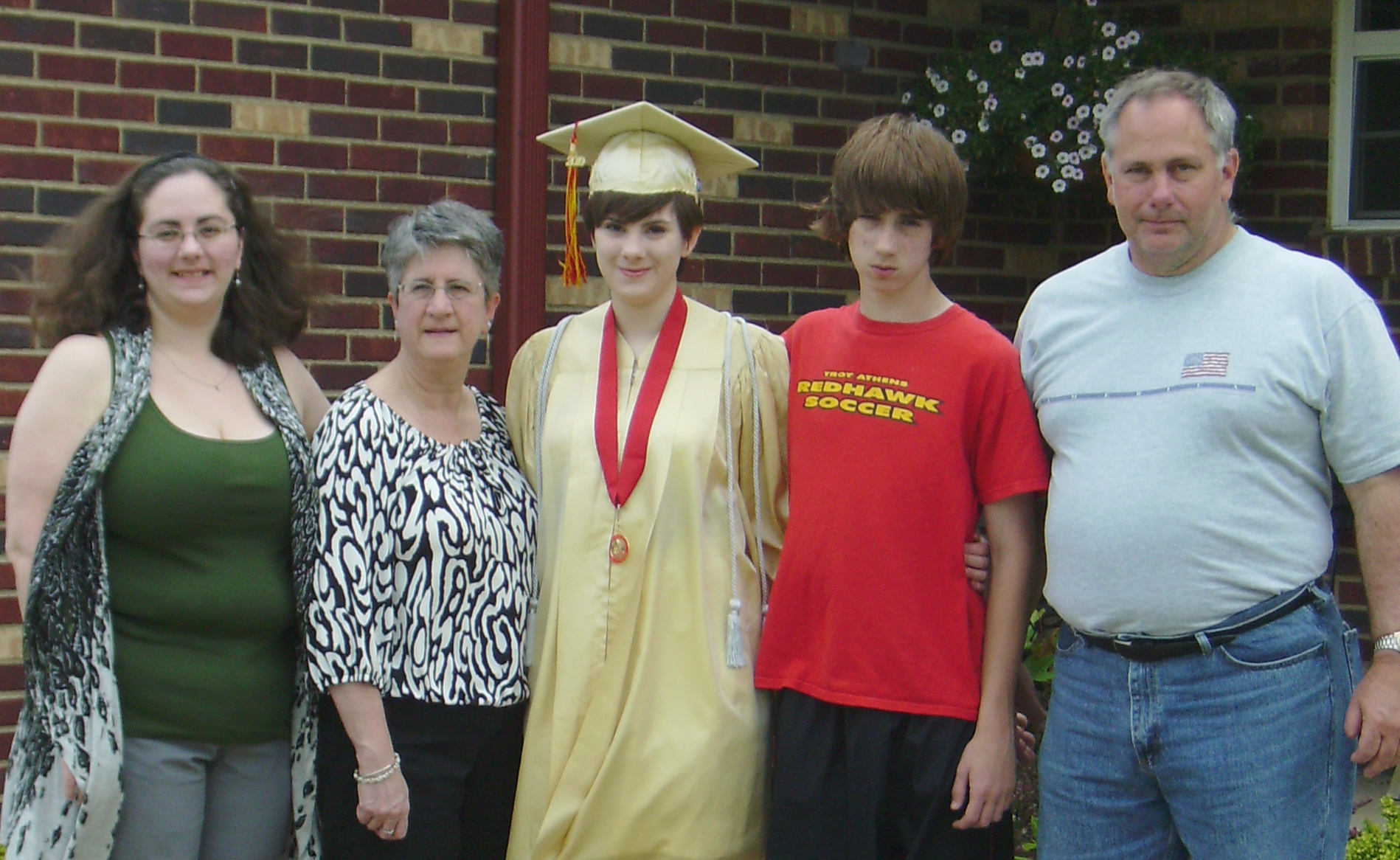
I did, however, find time to impress my grandparents with my sewing and clay-playing prowess while they were in town (in part perhaps because I found it difficult to consistently be on my laptop, which is a bad habit of mine but perhaps a good habit for someone who should be writing all the time).  I finished cutting out the 2.5×2.5 inch squares I needed for an absolutely insane quilt that I’m making, a pattern based on one found in a stash-busting quilt book (and believe me, I have quite a stash of cottons for quilting!).  I have a quarter and then a few rows of the quilt top sewn together as a result of my grandparents’ visit for Kendall’s graduation…and then I also go some more pendants made of sculpy, at least two of which are intended to be for earrings (and I think they’ll look cool after I sand them).